

5 Minutes
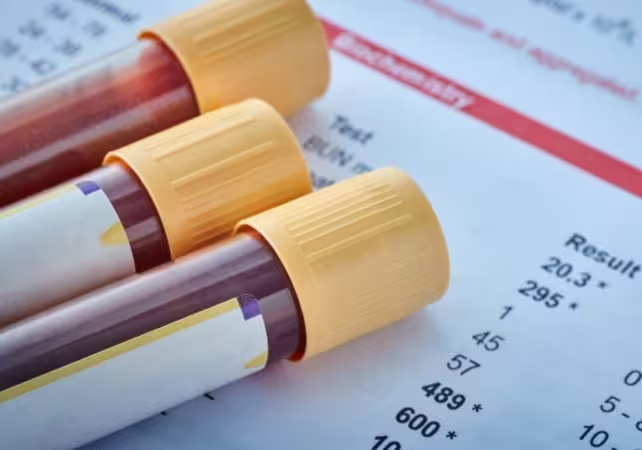
Imagine a routine blood draw—no scans, no invasive tests—that could flag whether your risk of dying in the next five to ten years is higher than expected. Recent large-scale research suggests signals in circulating proteins may carry subtle warnings about long-term health, and those signals could help doctors spot risk earlier than current methods allow.
Why scientists are looking to proteins in the blood
For decades clinicians have relied on age, weight, smoking history and a handful of routine blood tests to estimate a person’s future health. Those measures are useful, but blunt. They often provide only population-level probabilities rather than tailored insights for an individual. As health systems struggle with ageing populations and rising chronic disease, the pressure is growing to find earlier, more precise signals of risk.
Proteins circulating in the blood—collectively referred to as the proteome—offer a real-time window into physiological processes. Some proteins reflect ongoing inflammation, tissue repair or organ stress. Others track immune activation or early changes in cardiovascular health. By measuring thousands of proteins at once (a method known as proteomics), researchers can search for patterns that correlate with future outcomes, including mortality.
Large dataset, focused question: what did the study test?
Researchers analyzed data from the UK Biobank, a large national resource that has collected health information and biological samples from hundreds of thousands of volunteers. The analysis centered on more than 38,000 adults aged 39 to 70. Each participant provided a blood sample that was assayed for nearly 3,000 proteins. Investigators then tracked who survived or died over five- and ten-year intervals and looked for protein levels that statistically correlated with mortality from any cause (excluding accidents).
After adjusting the models for established risk factors—age, body mass index (BMI), and smoking status—the team identified hundreds of proteins associated with higher or lower risk of dying. From that long list they distilled compact protein panels: one panel of six proteins tied to five-year risk, and another of ten proteins linked to ten-year risk.

How much better were protein-based models?
- Traditional models using demographics and lifestyle variables performed near chance for predicting five- or ten-year all-cause mortality in this analysis.
- Incorporating the protein panels improved predictive accuracy beyond those basic models, but the improvement was modest rather than dramatic.
- In practical terms, the protein signatures acted more like risk flags—indicators to investigate further—rather than precise timers of when someone will get sick or die.
What these protein signals might mean clinically
Blood proteins are snapshots of internal biology. Elevated levels of certain proteins can indicate chronic low-grade inflammation, subtle organ strain, or early immune dysregulation—processes that precede overt disease. If validated, a protein-based risk profile could prompt clinicians to recommend more frequent monitoring, earlier cardiovascular screening, or intensified lifestyle interventions for people whose profiles look concerning.
Crucially, an elevated protein profile does not mean imminent death. It means increased relative risk compared with peers with different proteomic patterns, when other factors are equal. Such a signal could be analogous to a yellow traffic light for a patient’s future health: proceed with caution and investigate further.
Limitations and caveats—what the results don’t prove
There are several important limitations to bear in mind. First, the study shows associations, not causation. The proteins identified could be markers of processes that increase risk, or they could be bystanders reflecting other underlying conditions.

Second, pooling all causes of death into a single outcome reduces specificity. The biological pathways that lead to cancer, heart disease, infection, or organ failure differ markedly; a protein linked to one pathway may be irrelevant to another. This limits how precisely we can interpret a generic mortality signal.
Third, the predictive gains were modest. While protein panels outperformed simple demographic models, they do not yet deliver the kind of accuracy clinicians would need to make definitive decisions on their own. That's why further validation—across age groups, ethnicities and health backgrounds—is essential before such tools can enter routine practice.
Future directions: from research to routine care
For proteomic risk tests to move from promising research to clinical use, several steps are required:
- Large-scale validation in diverse populations to confirm that the same proteins predict risk across different ethnic groups and health systems.
- Standardization of assays so results are comparable across laboratories and over time.
- Clinical trials to test whether acting on an elevated protein profile—by offering earlier screening or preventive treatment—actually improves outcomes.
There is also a data-interpretation challenge: protein levels vary with age, medications, acute illness, and lifestyle. Any clinical test would need to be interpreted alongside a person's medical history, symptoms, and conventional risk factors.
Expert Insight
Dr. Aisha Raman, a clinical epidemiologist specializing in biomarker research, says: “Proteomics gives us a much richer signal than traditional blood tests. Think of it as moving from a black-and-white snapshot to high-definition video of internal biology. That said, we must temper excitement with rigor: associations are the first step, not the finish line. The clinical value comes only if interventions guided by these tests change real outcomes.”
Why this matters for public health
As populations age and chronic conditions become more common, health systems need smarter ways to target prevention and screening. A validated protein-based risk test could help prioritize patients who would benefit most from early intervention, potentially improving outcomes while conserving limited healthcare resources.
In short, the research points to an intriguing possibility: that the bloodstream contains measurable signals of future health beyond what we can infer from age, weight and lifestyle alone. The path from discovery to clinic will require careful validation, ethical oversight, and well-designed trials. But if protein panels can reliably flag elevated risk early enough to change care, they could become a valuable tool in preventive medicine.














Leave a Comment
Comments (2)
Whoa, a blood test that hints at your 10-year odds? kinda wild, but also scary. If it actually helps catch disease earlier, i'm all for it, but what about privacy and misuse?
Sounds intriguing but is this even actionable? hundreds of proteins, modest gains, could lead to overtesting and false alarms. Need real trials, not hype