
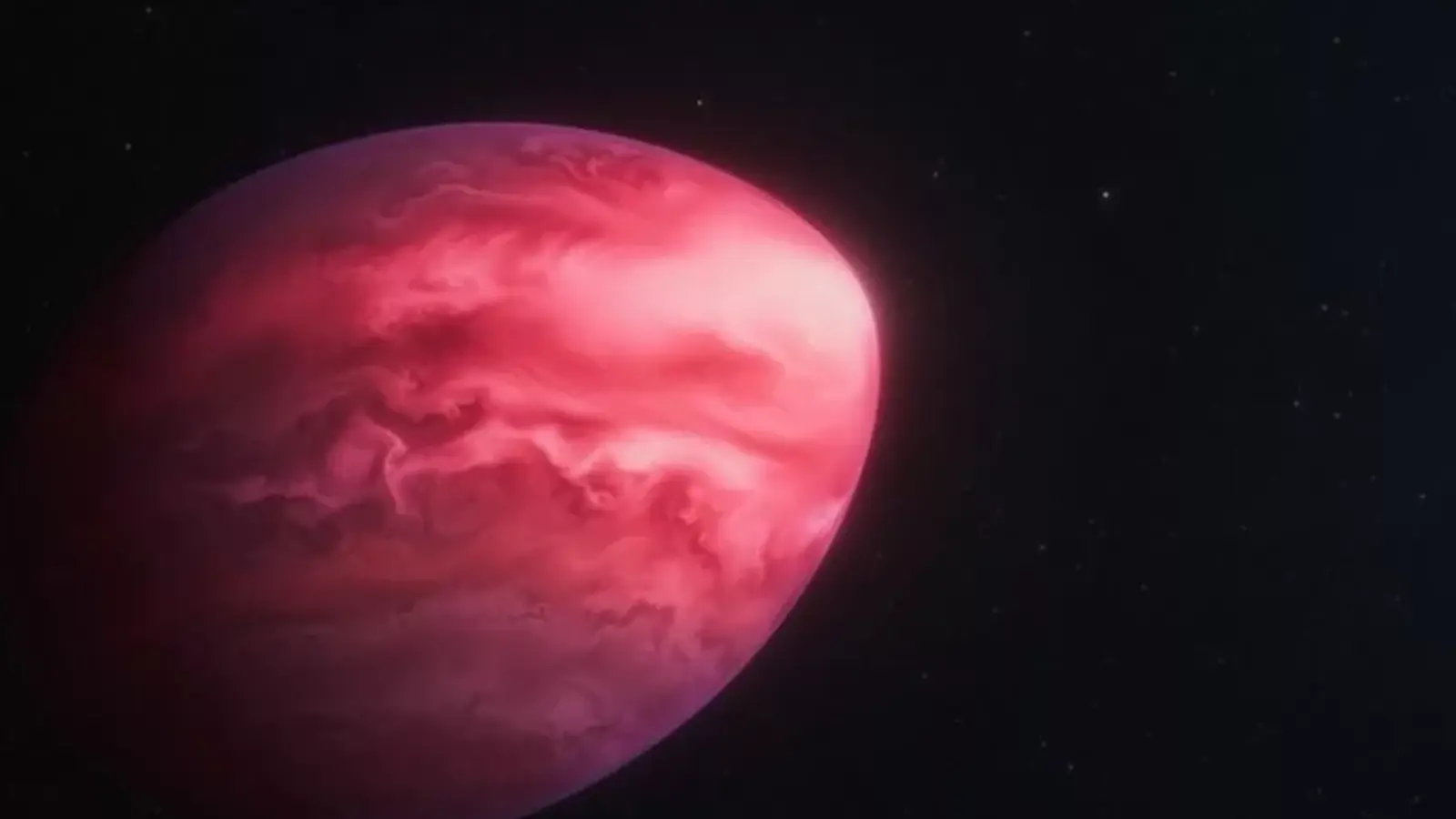
Space keeps delivering surprises. The James Webb Space Telescope (JWST) has spotted an exoplanet so unusual that astronomers are still puzzling over how it formed. Nicknamed a 'lemon-shaped' world, this object challenges our ideas about planetary shapes, atmospheres and interior chemistry.
A planet pulled into an odd shape by a deadly companion
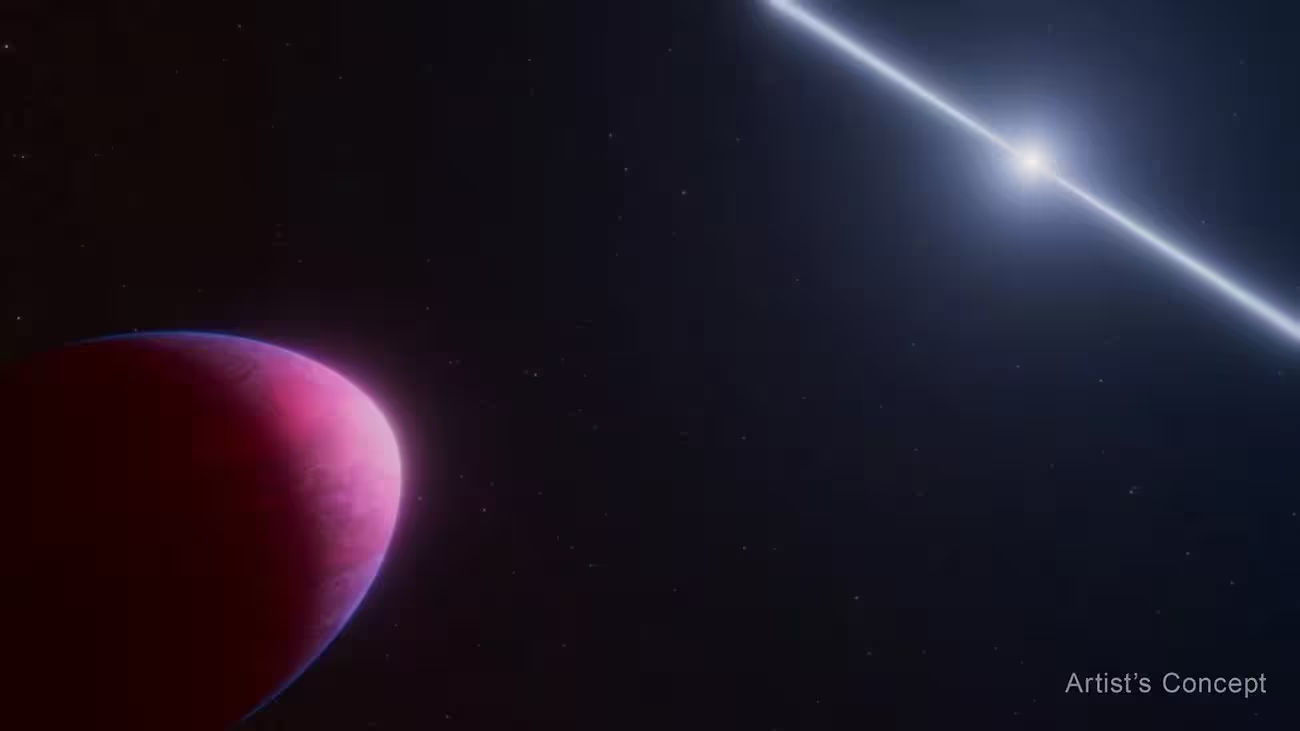
The object, designated PSR J2322-2650b, orbits a pulsar — a rapidly spinning, ultra-dense stellar remnant — at an astonishingly close distance of roughly one million kilometers. With a mass comparable to Jupiter but trapped in a razor-tight orbit that completes in just 7.8 hours, the planet is stretched by intense tidal forces. Those forces distort its spherical form into a pronounced ellipsoid that observers liken to a lemon.
What JWST actually saw in the atmosphere
JWST's infrared instruments detected an atmosphere unlike typical exoplanet envelopes. Instead of dominant water vapor or methane, the spectrum shows significant helium and molecular carbon signatures. Michael Zhang, lead investigator at the University of Chicago, described the find as 'a completely new kind of planetary atmosphere that no one has seen before.' Day-side temperatures reach about 2,000 °C, a regime where molecular carbon is surprising rather than expected.
Researchers propose that thick clouds of soot or carbon-rich aerosols may cloak the planet. Under extreme pressure deep below the atmosphere, carbon could crystallize — raising the tantalizing possibility of diamond formation or 'diamond rain' inside the world.
Born a planet — or a shredded star?
PSR J2322-2650b belongs to a class of binaries often called 'black widows.' In these systems the pulsar's energetic radiation and particle winds strip mass from a companion, sometimes to the point of leaving only a dense remnant. One scenario suggests the lemon-shaped object is the leftover core of a star that had its outer layers peeled away. Another possibility is that it formed as a normal planet but experienced extreme processing in the hostile pulsar environment.
Neither hypothesis fits all observations. If the object is a stripped stellar core, current nuclear physics models struggle to explain the apparent abundance of near-pure carbon. If it is a conventional planet altered after formation, its chemistry still defies standard planet formation models. As the research team put it after seeing the data: 'What is this thing? It directly contradicts our expectations.'
Why this discovery matters
Beyond the headline-grabbing shape, PSR J2322-2650b forces astrophysicists to rethink atmospheric chemistry under extreme conditions and the end stages of close binary evolution. JWST's sensitivity to faint infrared signatures is proving essential to reveal exotic compositions that previous telescopes would have missed.
Future observations — including longer JWST monitoring and complementary radio timing of the pulsar — will test whether the carbon signatures are global or confined to the hot day side, and whether the planet's interior truly harbors crystalline carbon. For now, this lemon-shaped exoplanet joins a short list of cosmic oddities that push the boundaries of planetary science.


Leave a Comment
Comments
No comments yet. Be the first.