

4 Minutes
Imagine stopping Alzheimer’s before the wreckage begins. Short of a cure, that’s the landscape researchers are trying to redraw — not by attacking the hardened wreckage of the disease, but by preventing the first fragile scaffolds from ever assembling.
Scientists at Tokyo Metropolitan University approached the problem from an unusual angle: polymer physics. Their work reframes a central mystery of Alzheimer’s disease — how tau proteins, long implicated in neurodegeneration, transition from soluble molecules to toxic fibrils — by showing that fibrils do not appear spontaneously. Instead, tau first gathers into soft, reversible clusters tens of nanometers across. These clusters act as precursors. Break them up early, and the fibrils that are associated with neuronal damage never take hold in solution.
How the experiment worked and what they saw
Tau proteins are charged, flexible chains. In living brains they interact with many partners; in the lab they respond to salt, cofactors such as heparin, and other ions the way polymers respond to solvent conditions. Using small-angle X-ray scattering and fluorescence-based assays, the team tracked tau in solution and detected a reproducible, intermediate state: loose, dynamic condensates that precede the formation of rigid fibrils.
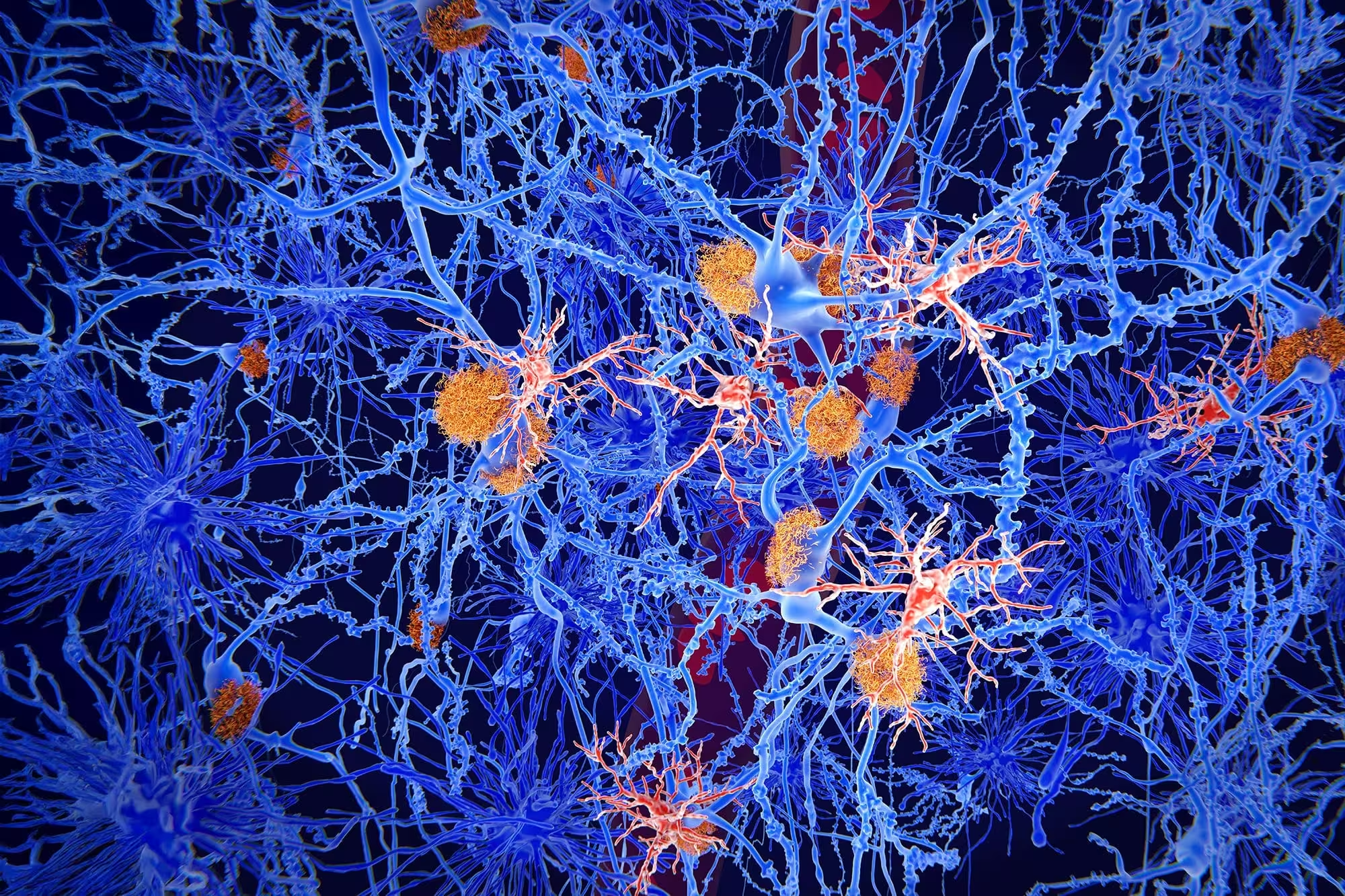
Those condensates are not aggregates in the classic, irreversible sense. They form and dissolve depending on the chemical environment. When researchers elevated sodium chloride concentration in the presence of heparin — a compound often used in laboratory models to accelerate tau assembly — the clusters melted away. Without those clusters as nucleation platforms, fibrillization stalled. In short: change the environment, and the pathway to pathological fibrils can be blocked at its earliest stage.
Why this matters for therapy
Most therapeutic efforts to date have targeted mature fibrils or downstream toxicity. That’s hard. Mature fibrils are stable. They are embedded in neuronal tissue and resistant to clearance. The Tokyo team suggests an alternate tactic: intercept the process upstream, while it is still reversible. Prevent the clusters from forming and you remove the seedbeds that give rise to insoluble fibrils.
Mechanistically, the effect depends on electrostatic interactions. Heparin is highly charged and binds tau; increasing ionic strength screens those charges, weakening tau–heparin interactions and destabilizing the precursor clusters. That’s a basic physical chemistry principle — electrostatic screening — applied to a biological problem. It implies we can modulate pathological assembly by tweaking molecular context rather than brute-forcing fibrils apart.
Are we looking at a universal principle? Possibly. Polymer-like behaviors have been observed in other aggregation-prone proteins, and many neurodegenerative disorders feature stepwise assembly pathways. If reversible precursor states are common, strategies aimed at dissolving or preventing these early condensates could become a platform technology for several diseases, not only Alzheimer’s.
Implications, caveats, and next steps
Laboratory solutions are controlled environments. Cells are not. Tau interacts with microtubules, chaperones, post-translational modifications and myriad partners that may alter its propensity to cluster. Translating a salt-dependent effect into a therapy requires approaches that mimic the same destabilizing influence without harming physiology. That could mean small molecules that disrupt tau–cofactor binding, biologics that cap transient assemblies, or delivery of modulators that alter local ionic microenvironments in vulnerable neurons.
This line of thinking also nudges biomarker development. If transient clusters exist in the earliest stages of disease, new imaging or fluid biomarkers that detect them could identify patients long before irreversible pathology accumulates. Earlier detection plus interventions that target precursor stages — a one-two punch — could reshape how we treat chronic neurodegeneration.
Expert Insight
“The novelty here is conceptual,” says Dr. Maya Venkataraman, a neurobiophysicist not involved in the study. “We often assume aggregation is a downhill, one-way process, but many biological assemblies are reversible. If we can learn to steer that reversibility, we gain leverage. The challenge will be specificity — dissolving pathological clusters while leaving normal cellular condensates intact.”
The Tokyo Metropolitan University results do not promise an immediate cure. They do, however, offer a tractable target: the fragile moments before tau commits to pathology. In those moments, the rules are different. Interventions can be gentler, tunable, and — perhaps most importantly — preventive. The question now is whether we can translate a physical chemistry insight into safe, effective tools for the clinic.








Leave a Comment
Comments (2)
Is this even true in real brains? Salt screening in a test tube seems miles from neurons full of cofactors, chaperones etc. Curious but wary.
Wow this is wild. Stopping tau before it wrecks neurons? Hopeful but cautious, if it works in vivo this could change everything... maybe too optimistic?