

Tiny plastic particles are raining down on landscapes and seas alike — and the sky holds far more of them than researchers expected. The latest study recalculating atmospheric microplastic loads finds land-based sources lofting an astonishing 600 quadrillion particles into Earth’s atmosphere every year, a figure that forces us to rethink where airborne plastic comes from and how widely it travels.
Land releases dominate atmospheric microplastic pollution: about 600 quadrillion particles annually.
How the new estimate was reached
Previous attempts to quantify airborne microplastics often varied wildly. Measurements taken at different coasts and cities produced numbers that could differ by orders of magnitude. To cut through that scatter, the research team compiled 2,782 measurements from 283 sites around the globe and analyzed them with consistent assumptions about particle size, sampling efficiency and atmospheric transport. The result: a substantially larger estimate than many earlier studies — and a far clearer signal that continental sources dwarf the ocean’s contribution.
Comparatively, the oceans were estimated to inject roughly 26 quadrillion particles per year, making land nearly 20 times more significant in the atmospheric plastic budget. On a per-volume basis, average concentrations came out to about 0.08 particles per cubic meter over land and 0.003 per cubic meter over the open ocean. Those small numbers belie a huge total when multiplied across the planet’s atmosphere.
Why this matters and what drives the discrepancy
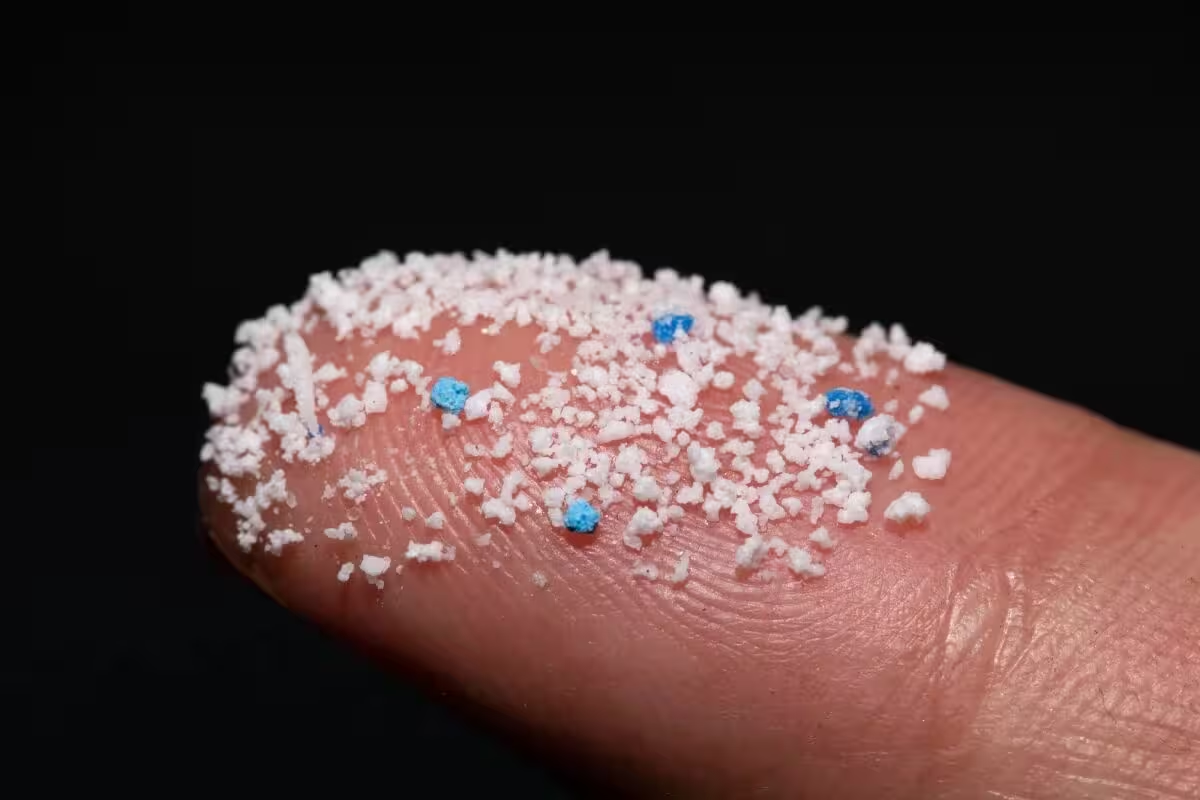
Microplastics — defined here as fragments ranging from one micron up to five millimeters — are light and easily picked up by wind. Once airborne, they can travel long distances, settling in remote deserts, polar ice and mountain ranges. Their physical properties make them both hard to detect reliably and essentially impossible to remove from natural cycles once released.
So why were earlier estimates so much lower? The new analysis suggests past studies were limited by inconsistent sampling methods and local variability. For example, measurements along the southeast coast of China once reported concentrations anywhere from 0.004 to 190 particles per cubic meter — a spread too wide for a reliable global picture. By harmonizing datasets and applying a unified modeling approach, researchers narrowed uncertainties and revealed a much larger atmospheric load.
Andreas Stohl, an atmospheric scientist at the University of Vienna and lead author on the study, notes that "uncertainties in emission estimates remain," but adds that the new work significantly tightens the bounds on the relative roles of land and sea. That clarity matters: policy makers and environmental monitors need realistic baselines if they are to design effective standards and track progress.
Implications and next steps
Higher-than-expected airborne microplastic counts raise questions about exposure pathways, ecosystem impacts and long-range transport processes. While this study offers a stronger scientific baseline, it also points to clear gaps: standardized global monitoring, better methods for capturing the smallest particles, and integrated models that link human activity, weather patterns and particle fate.
Scientists expect these findings to serve as a foundation for future work — enabling detection of even tinier fragments and supporting international efforts to monitor and mitigate plastic pollution. The atmosphere, it turns out, is not an escape hatch for our plastic waste; it is a circulation system, carrying microscopic traces of our materials across continents and into places we once thought untouched.


Leave a Comment
Comments
No comments yet. Be the first.