
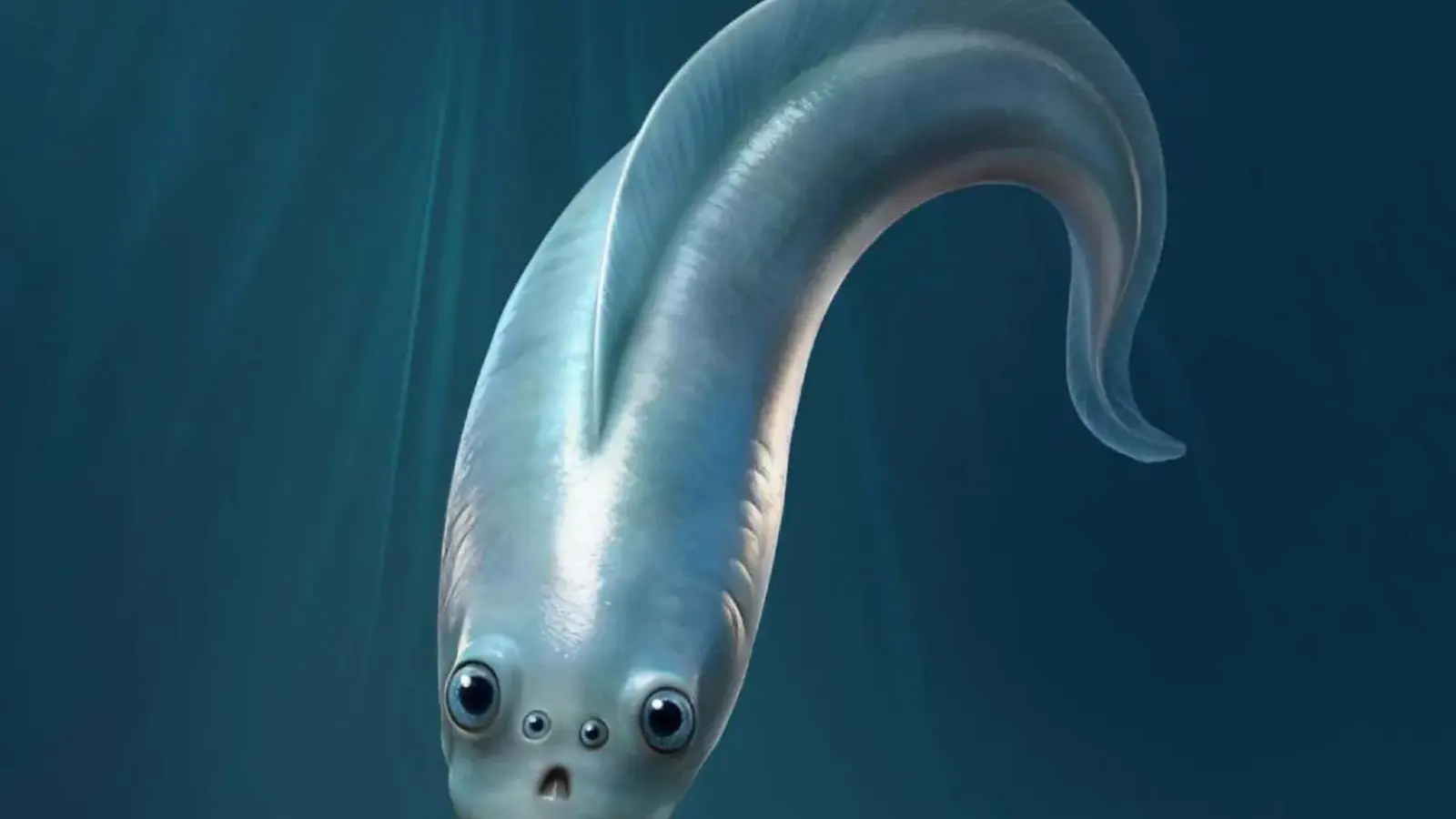
Imagine a fish so keen-eyed that it watched the Cambrian seas with four functional eyes. Strange as it sounds, fossils uncovered along the shores of Dianchi Lake in China suggest just that: some of Earth’s earliest vertebrates navigated ancient waters with two pairs of camera-type eyes, a visual arrangement whose evolutionary echo survives inside modern humans as the pineal gland.
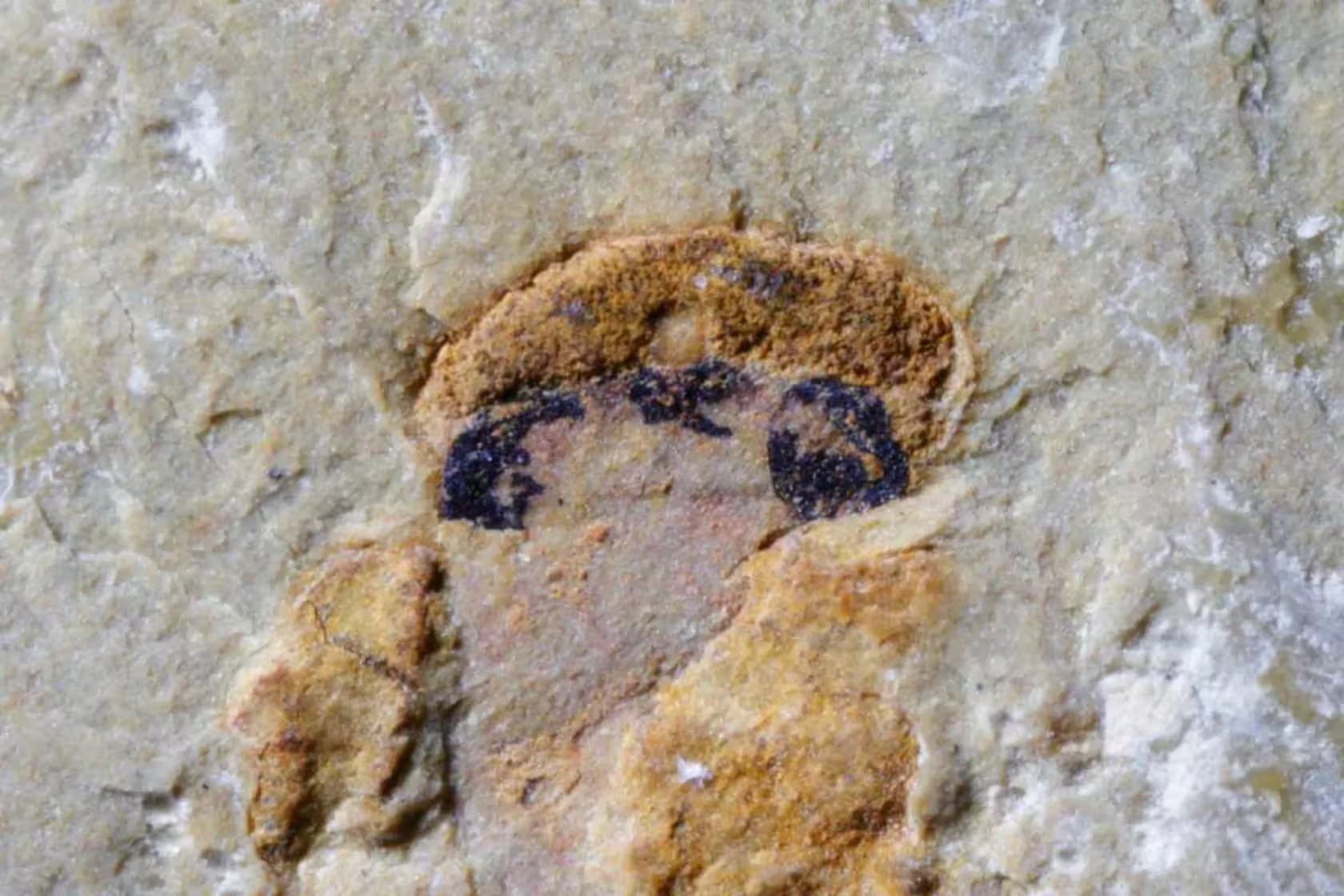
Between 2019 and 2024, Piyan Kong and colleagues from Yunnan University excavated exceptionally preserved remains of early jawless fishes—members of the Myllokunmingiid group—buried in Chengjiang’s famed soft-sediment lagerstätte. These sites are renowned because even delicate soft tissues, not just bones, can fossilize there. Under electron microscopes the team found melanosome-rich patches in positions that line up with what would be two primary eyes and an additional, smaller pair. Those dark smudges, long dismissed in some specimens as nasal or olfactory tissue, now read differently: they carry the microstructural hallmarks of lenses and retinal pigment.
"Even more striking was the presence of lens traces in both the lateral and central pairs of eyes," said Jacob Winter of the University of Bristol, commenting on the microscopic evidence. When researchers re-examined the patterns and distributions of melanosomes—pigment-containing organelles that can survive fossilization—they could reconstruct a surprisingly advanced visual apparatus. Instead of a simple two-eyed head, these early vertebrates likely had a compound visual strategy: large lateral eyes for high-resolution detail and small, central eyes optimized for motion detection and rapid threat assessment.
Scientific context and methods
The finds fall within the Cambrian Explosion, roughly 518 million years ago, a geological period when body plans and sensory systems diversified rapidly. Eyes have evolved many times across life: arthropods developed compound eyes composed of thousands of ommatidia; vertebrates converged on camera-style eyes with a lens, retina, and iris. What sets these fossils apart is the preservation of melanosomes and soft anatomy indicating more than a single camera-eye pair on each side of the skull.
Researchers combined high-resolution scanning electron microscopy, mapping of melanosome geometry, and comparative anatomy with extant vertebrates. The spatial arrangement of pigment granules, together with impressions of soft tissues surrounding the orbital region, matched structures known to serve optical functions. That pushed the interpretation away from olfactory organ remnants toward bona fide visual organs. The team published their work in Nature, where they argue the central eye pair gradually lost its image-forming role during vertebrate evolution and became the pineal complex—or pineal eye—seen in some modern reptiles as a light-sensitive organ, and in mammals as the pineal gland controlling circadian rhythms via melatonin secretion.
Why would an early vertebrate evolve four eyes? The Cambrian seas were crowded and perilous. Multiple viewpoints offered clear survival advantages: broad fields of view to spot predators and prey, redundancy against injury, and fast motion-sensitive detection while large lateral eyes resolved fine detail. In short, a visual system engineered both for alertness and precision.
Implications for vertebrate evolution
Tracing a light-sensing structure from a Cambrian fish to the human pineal gland reframes a small part of our sensory ancestry: what is now an endocrine timing organ once contributed to direct vision. This is not mere curiosity. Recognizing such hidden homologies helps paleobiologists understand how complex traits are repurposed through deep time. It also nudges researchers to re-evaluate fossil remains that were previously labeled as non-visual soft tissues—some may hide unexpected sensory anatomy if examined with modern imaging and molecular proxies.
The study also underscores the importance of melanosomes as windows into ancient biology. These microscopic pigment carriers preserve well and record more than color—they preserve anatomical context. With refined imaging and biochemical assays, paleontologists are reading pigment patterns as anatomical maps, revealing organ placement and tissue types even where bones are absent.
Expert Insight
"When you combine ultrastructure with ecological reasoning, a coherent picture emerges," says Dr. Mira Alonzo, a vertebrate paleobiologist unaffiliated with the study. "Four eyes make sense in a world full of ambush predators and rapid, confusing motion. Evolution keeps what works—and then tucks it away in new forms when environments change."
What remains unresolved are the pathways and selective pressures that turned an image-forming organ into a light-sensitive gland. Future work will probe developmental genetics in living vertebrates to map homologies more precisely. For now, these fossil eyes remind us that the anatomy of modern animals carries stubborn, surprising traces of lives lived half a billion years ago—eyes that once watched the earliest vertebrate dramas unfold.

Leave a Comment
Comments (2)
Is the melanosome evidence really enough to call them lenses? Feels tentative, could it be taphonomy or preservation bias? If true tho...
Wow, four eyes on a Cambrian fish? That's wild, imagine tiny sockets scanning the murky sea. The pineal link gives me chills... need more pics, fossils look unreal