
4 Minutes
People often mutter to themselves when wrestling with a problem. It feels odd when a machine does the same, but that very oddity may be a powerful shortcut toward smarter artificial intelligence.
Inner speech — the quiet running commentary we use to rehearse steps, check assumptions, or hold ideas in mind — is a staple of human thought. Researchers at the Okinawa Institute of Science and Technology (OIST) have borrowed that strategy for machines. Their work shows that pairing an AI's internal self-talk with a working memory architecture lets models learn more flexibly, generalize from less data, and juggle multiple tasks with far better grace than conventional systems.
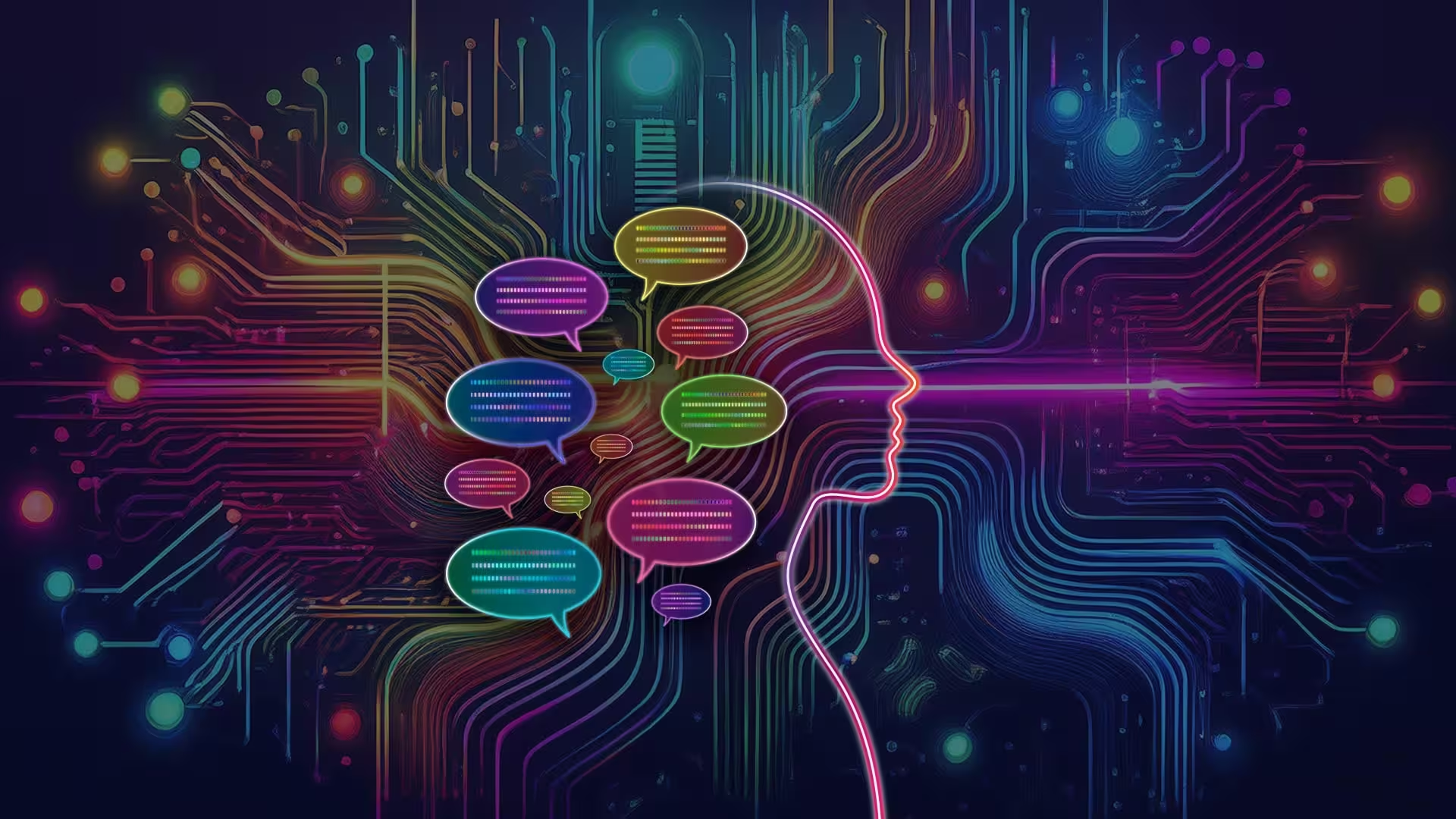
Inner speech and working memory architecture boost AI performance when multitasking and completing complex pattern generation challenges.
Turning self-mutiny into a learning tool
How do you teach a model to talk to itself? The OIST team framed internal utterances as short, task-oriented prompts the system repeats to itself while processing information — think of them as whispered reminders or a mental checklist. When these prompts are combined with a working memory made of several temporary "slots," the system can hold multiple items simultaneously and manipulate them as steps unfold. The result: improved performance on tasks that require holding and transforming sequences, such as reversing lists or reconstructing complex patterns.
There is a pragmatic appeal to this approach. Large-scale models usually demand enormous labeled datasets to generalize beyond training examples. The OIST experiments suggest an alternate route: architecture and interaction dynamics matter. In other words, how a model is trained to interact with its own internal signals can shape its ability to apply rules in new contexts, reducing dependence on brute-force data collection.
"Learning is not only about wiring," says Dr. Jeffrey Queißer of OIST's Cognitive Neurorobotics Research Unit. "By structuring training so the system practices self-interactions, we change the dynamics of learning itself."
Why working memory reshapes generalization

Working memory, in human terms, is the mental whiteboard where we sketch calculations and keep immediate goals in sight. For machines, it plays an analogous role: holding transient tokens or intermediate results that algorithms need to reference and reuse. The research tested different memory designs and found that multiple independent slots — temporary containers that can store discrete pieces of information — gave models a tangible advantage on multi-step problems.
Tasks that demand orderly manipulation of several items at once expose the weakness of simple recurrent designs. When an AI must reverse a sequence or generate a multi-part pattern, it needs to keep track of multiple values in parallel and update them reliably. Adding inner-speech targets — explicit internal prompts that the model is trained to produce and consult — boosted accuracy and sped up learning, especially when data were sparse.
There is an elegance to this result: instead of scaling up model size and feeding it more examples, designers can refine the memory mechanisms and include structured internal signaling to get more intelligence from less data. That has immediate implications for fields such as robotics, where collecting massive labeled datasets is costly or impractical.
Experimental context and next steps
The experiments reported in Neural Computation focused on controlled algorithmic tasks meant to probe generalization and multitasking. These tasks are deliberately abstract so that researchers can isolate the roles of memory and self-directed speech, but the team acknowledges the need to move toward messier, real-world conditions. Noisy sensors, partial information, and changing goals are the everyday realities of household and agricultural robots; the next round of studies will introduce such complexities to see whether the inner-speech plus working-memory recipe still yields dividends.
Beyond engineering, this line of inquiry bridges to cognitive neuroscience. By modeling inner speech and temporary storage in machines, scientists can test hypotheses about how the human brain coordinates thought and action. It is a two-way street: insights into human development and language-internalization can inform model architectures, and machine experiments can suggest new angles for biological research.
Expert Insight
"This is a sensible direction for building more adaptable systems," says Dr. Maya Patel, a cognitive robotics researcher unaffiliated with the study. "We ask machines to behave in dynamic environments, but we rarely give them the internal scaffolding that humans rely on — the ability to rehearse, to hold multiple intermediate goals, to mutter a plan under their breath. Combining these elements is a lightweight, interpretable complement to scaling up data and parameters."
The OIST work does not promise an instant replacement for data-hungry deep networks. Instead, it opens a practical avenue: small adjustments to training and memory design that make models more robust, efficient, and capable of transferring learned procedures to unfamiliar problems. If inner speech helps humans think, perhaps it will help machines, too — quietly, step by step, as they learn to do more with less.












Leave a Comment
Comments (2)
seems clever, but feels a bit overhyped. Robots in farms are messy, I want to see noisy sensor results first. not sold yet
Wow a machine muttering to itself? wild but kinda promising! If it really cuts data needs this could be huge, though I worry about noise, real world tests?