
8 Minutes
A puzzling cosmic blast picked up in both light and gravitational waves may point to a never-before-seen hybrid explosion: a "superkilonova" — a kilonova born inside the debris of a recent supernova. If confirmed, this double act could change how astronomers think neutron stars form, merge and seed the universe with heavy elements.
A rare double blast: first signals and telescopes
On August 18, 2025, gravitational-wave observatories in the U.S. and Europe picked up a transient ripple in space-time. The twin LIGO detectors in Louisiana and Washington, together with the Virgo instrument in Italy, registered an event that looked like a compact-object merger — but with an odd detail: at least one of the colliding bodies appeared unusually light, possibly less massive than the Sun.
Minutes after the LIGO–Virgo alert, the Zwicky Transient Facility (ZTF) at Caltech’s Palomar Observatory identified a rapidly fading red transient roughly 1.3 billion light-years away. Initially flagged as ZTF 25abjmnps and later cataloged as AT2025ulz, the optical source matched the gravitational-wave localization close enough that many teams began intense follow-up observations.
Dozens of telescopes joined the hunt. Instruments from Keck Observatory in Hawaiʻi to the Fraunhofer telescope at Wendelstein Observatory in Germany, plus a network of facilities that had collaborated via the GROWTH program, trained on the fading red glow to gather spectra, photometry and time-resolved measurements.
At first, a familiar glow — then a twist
Early observations of AT2025ulz looked strikingly similar to the kilonova from GW170817, the landmark 2017 neutron-star merger. The source faded quickly and emitted strong red light — a color signature typically associated with heavy elements such as lanthanides, gold and platinum that efficiently block blue photons and reprocess energy at longer wavelengths.
But the story grew stranger. Days after the initial red flash, the transient brightened again, shifted toward bluer wavelengths and began showing hydrogen in its spectra. Those traits are classic hallmarks of a stripped-envelope core-collapse supernova, not a clean kilonova. A number of astronomers concluded AT2025ulz was simply a conventional supernova unrelated to the gravitational-wave trigger.
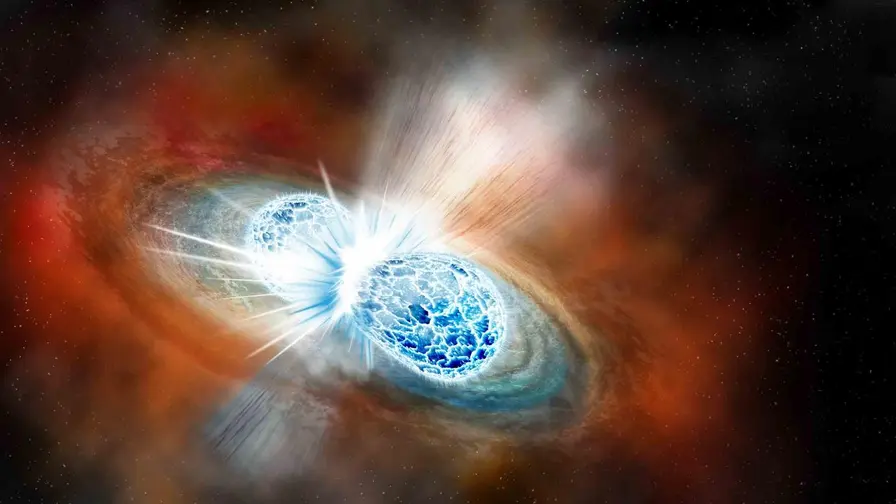
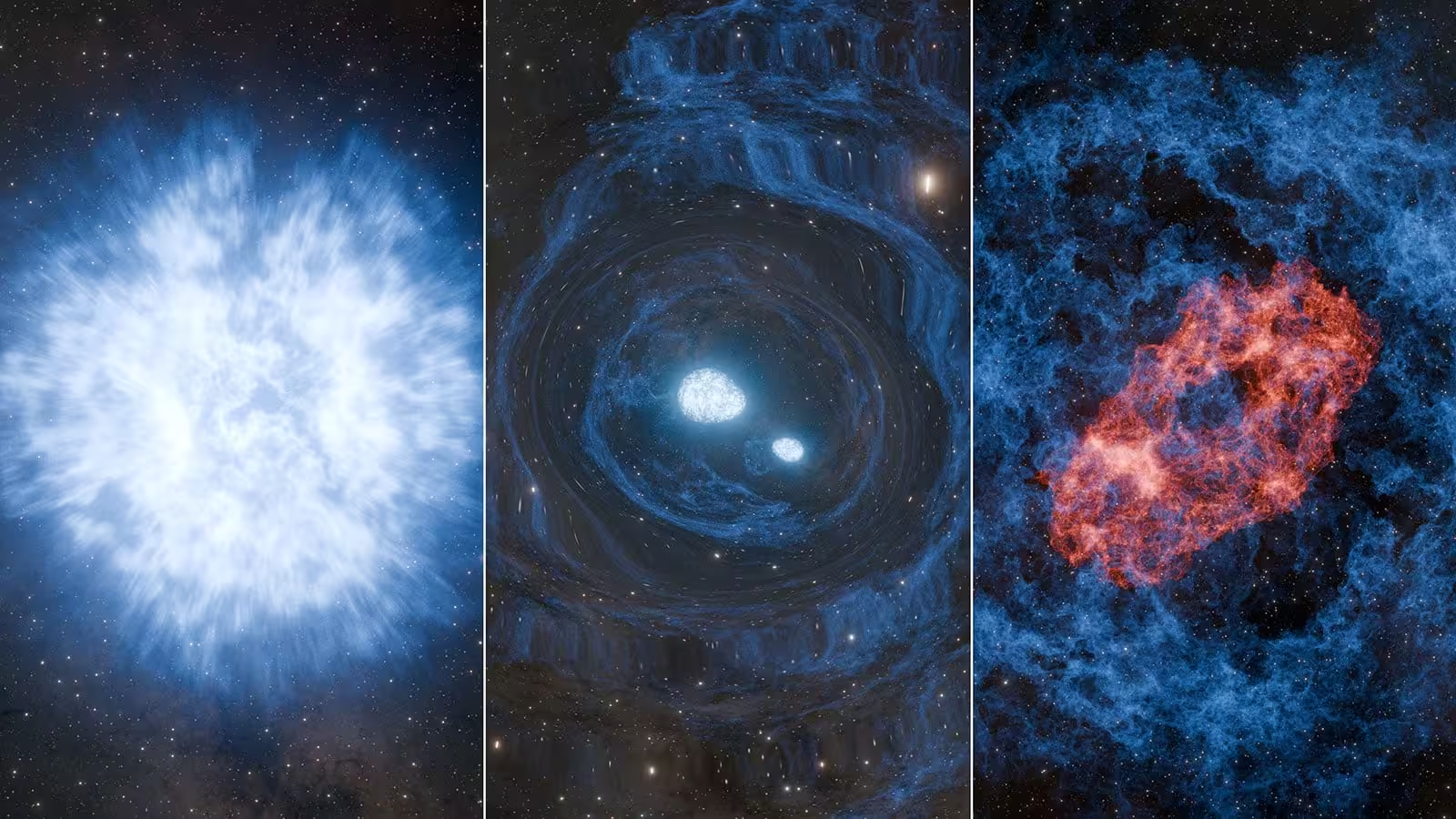
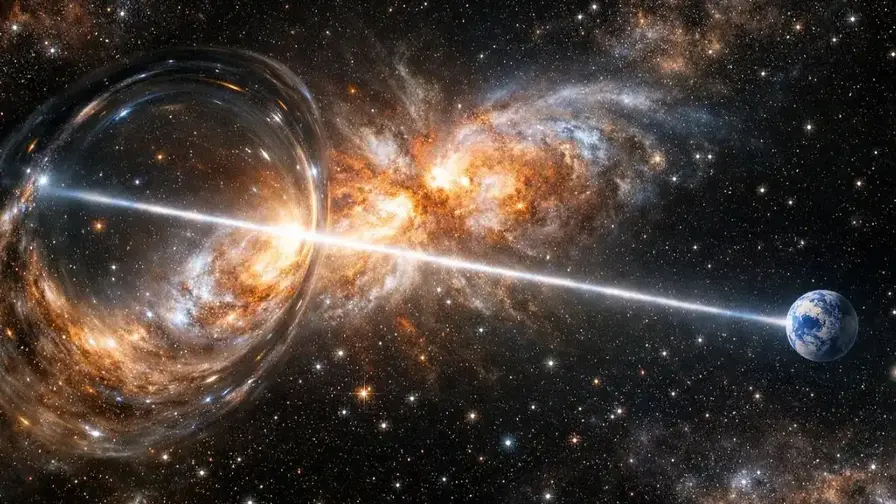
This artist’s concepts shows a hypothesized event known as a superkilonova. A massive star explodes in a supernova (left), which generates elements like carbon and iron. In the aftermath, two neutron stars are born (middle), at least one of which is believed to be less massive than our Sun. The neutron stars spiral together, sending gravitational waves rippling through the cosmos, before merging in a dramatic kilonova (right). Kilonovae seed the universe with the heaviest elements, such as gold at platinum, which glow with red light.
Why astronomers are entertaining a single, combined explanation
Caltech astronomer Mansi Kasliwal, lead author on the new paper in The Astrophysical Journal Letters, argues the combined dataset resists simple classification. "At first, for about three days, the eruption looked just like the first kilonova in 2017," she said. When the transient shifted toward supernova-like behavior, many researchers moved on — but Kasliwal's team kept watching and modeling.
Two core clues underpin the superkilonova hypothesis. First, the gravitational-wave signal implies at least one constituent had a mass below typical neutron-star masses, suggesting a sub-solar neutron star, an exotic object some theories predict but which had not been directly observed. Second, the early red kilonova-like emission was contemporaneous with a later supernova-like brightening, consistent with a scenario in which a kilonova erupted within or behind expanding supernova ejecta, partially obscuring and then later revealing different emission components.
David Reitze, executive director of LIGO, emphasized caution: "While not as highly confident as some of our alerts, this quickly got our attention as a potentially very intriguing event candidate. We are continuing to analyze the data, and it's clear that at least one of the colliding objects is less massive than a typical neutron star." The data remain noisy and the localization volumes are large, but the coincidence of a gravitational-wave trigger and a fast red transient is compelling enough to explore exotic models.
How a supernova could birth a kilonova
Neutron stars normally arise when massive stars end their lives through core-collapse supernovae. Typical neutron-star masses range from about 1.2 to roughly three solar masses, compressed into a sphere about 20–25 kilometers across. But theorists have proposed mechanisms by which much lighter, "sub-solar" neutron stars might form during the violent death throes of extremely rapidly spinning stars.

Two leading scenarios explain how a collapsing star could produce tiny neutron-star fragments. In one, called fission, centrifugal forces during an asymmetric collapse can effectively split the core into two smaller remnants. In the other, fragmentation, a dense, unstable disk forms around the collapsing star; clumps in that disk coalesce, giving birth to low-mass compact objects in a process analogous to planet formation.
Brian Metzger, a co-author on the paper and a theorist at Columbia University, notes that if two such newborn sub-solar neutron stars form close together, gravitational-wave emission could drive them to merge on short timescales. "If these 'forbidden' stars pair up and merge by emitting gravitational waves, it is possible that such an event would be accompanied by a supernova rather than be seen as a bare kilonova," Metzger explained.
In this picture, the supernova explodes first, producing bright, hydrogen-rich material that expands outward. Inside or shortly after that expanding shell, the two tiny neutron stars spiral together and merge, producing a kilonova that initially shines in the red as heavy elements form. The visible signature would be a layered temporal sequence: a red kilonova-like flash embedded within — and later blended into — the evolving supernova spectrum.
Scientific implications: element formation and neutron-star physics
If superkilonovae exist, they expand the environments where the universe's heaviest elements—gold, platinum, uranium—can form. Standard kilonovae already contribute substantially to heavy-element production through rapid neutron capture (r-process) in merger ejecta. A kilonova occurring inside supernova material could alter the thermodynamic conditions, neutron richness and opacity of the outflow, potentially producing a different inventory or distribution of r-process nuclei.
Beyond nucleosynthesis, confirming sub-solar neutron stars would force theorists to rethink collapse physics. The existence of such light compact objects would provide empirical constraints on angular momentum transport, magnetic braking and fragmentation thresholds in pre-supernova cores. It would also open a new channel for compact-object mergers and gravitational-wave sources, with signatures that differ from typical neutron-star binaries.
How scientists will test the superkilonova idea
The team responsible for this discovery is careful to stress that AT2025ulz is not definitive proof of superkilonovae. The current dataset is intriguing but ambiguous. The way forward is straightforward in principle: find more such coincidences and improve model fits across electromagnetic and gravitational-wave bands.

Upcoming and next-generation facilities will help. Surveys like the Vera C. Rubin Observatory's Legacy Survey of Space and Time (LSST) will dramatically increase the discovery rate of fast transients. NASA missions such as the Nancy Grace Roman Space Telescope and the proposed UVEX mission will provide complementary ultraviolet and infrared coverage. Ground-based networks — including arrays like Caltech's Deep Synoptic Array-2000 — expand radio follow-up capability, while specialized projects like Caltech's Cryoscope in Antarctica could probe long-wavelength time-domain signatures.
Kasliwal underscores a practical lesson: "Future kilonovae events may not look like GW170817 and may be mistaken for supernovae. We can look for new possibilities in data like this from ZTF as well as the Vera Rubin Observatory... We do not know with certainty that we found a superkilonova, but the event nevertheless is eye opening." That admonition speaks to a broader point for time-domain astronomy: diversity in transient behavior is the rule, not the exception.
Expert Insight
"This candidate event forces us to be creative in our models," says Dr. Elena Soto, an observational astrophysicist at the University of Arizona not involved with the study. "If a kilonova can be embedded inside supernova ejecta, we need joint electromagnetic and gravitational-wave pipelines that can tease apart overlapping light curves and spectra. It's a data-analysis as much as a theoretical challenge."
Dr. Soto adds that multi-messenger coordination — rapid gravitational-wave alerts followed by robotic optical, infrared and radio follow-up — will be essential. "The first few hours and days are where the most diagnostic information hides," she notes. "Missing that early window could let interesting events slip through the cracks and be cataloged as run-of-the-mill supernovae."
What to watch for next
Confirming superkilonovae will require: a) repeated coincidences between gravitational-wave triggers and unusual optical transients; b) spectra that show an initial r-process–dominated signature followed by later hydrogen-rich or supernova-like features; and c) theoretical models capable of reproducing layered emission and the expected nucleosynthetic yields.
For the broader community, AT2025ulz is a reminder that surprises remain plentiful in the transient sky. Instruments are now sensitive enough to catch faint, fast, and complex events. As the number of detected mergers and transients grows, astronomers will refine event classifications and expand the taxonomy of explosive phenomena — potentially adding superkilonovae to the roster.
Ultimately, the extraordinary claim — that a supernova can give birth to neutron stars which promptly merge in a kilonova — will stand or fall on repeat observation. Until then, AT2025ulz remains an intriguing candidate that expands the questions scientists ask about stellar death, neutron-star birth, and the cosmic origins of the heaviest elements.







Leave a Comment
Comments (3)
Feels a bit overhyped, they saw a weird light curve and jumped to exotic models. still, cool idea — Rubin and LSST will tell us soon
Is this even true? sub-solar neutron stars sound speculative, could be a misclassified SN. Need more coincidences, better spectra, time-resolved obs
wow didnt expect that, a kilonova inside a supernova? mind blown. if true, total game changer for origin of heavy elements, but...