
4 Minutes
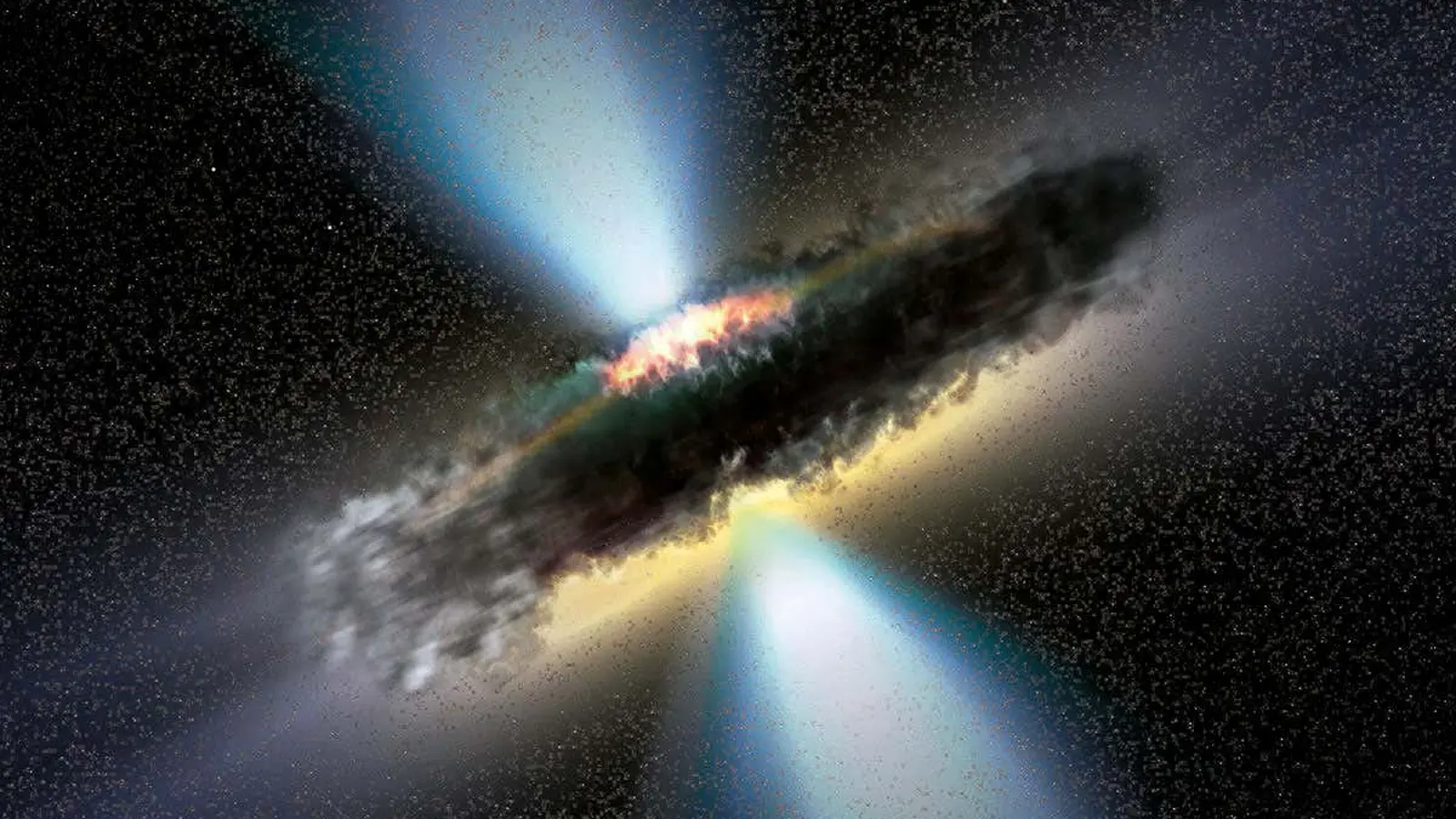
Dark matter shapes galaxies and the large-scale structure of the universe, yet its internal behavior remains one of cosmology’s thorniest puzzles. Researchers at the Perimeter Institute have released a new computational tool that opens a window into the life cycle of self-interacting dark matter halos—massive, invisible structures that cradle galaxies like the Milky Way.
A clearer computational lens on dark matter
For nearly a century scientists have inferred dark matter’s presence from gravity’s fingerprints: stars orbit faster than expected, galaxy clusters bend light, and cosmic web filaments trace a hidden scaffold. But the microscopic properties of dark matter particles—whether they collide with one another or remain essentially collisionless—dramatically change how halos evolve.
Perimeter Institute researchers James Gurian and Simon May (formerly of Perimeter) published a study in Physical Review Letters describing KISS-SIDM, a new code designed to model self-interacting dark matter (SIDM) across regimes that previous methods struggled to bridge. SIDM particles exchange energy through rare collisions, and those exchanges can reshape a halo’s center over billions of years.
Why self-interacting dark matter matters
Self-interactions change halo cores in ways that could resolve tensions between observations and standard cold dark matter models. In collisionless dark matter, halos tend to form steep, dense centers. But many observed dwarf galaxies and low-surface-brightness systems show shallower cores. If dark matter particles interact with each other, energy flows outward from the inner regions, softening the density profile and potentially matching observations.
"Dark matter forms diffuse clumps that are still far denser than the cosmic average," says James Gurian, a postdoctoral fellow at Perimeter Institute. "How energy is transported inside those clumps determines whether the center stays cored or collapses into a denser state."
Gravothermal collapse: gravity that heats as it loses energy
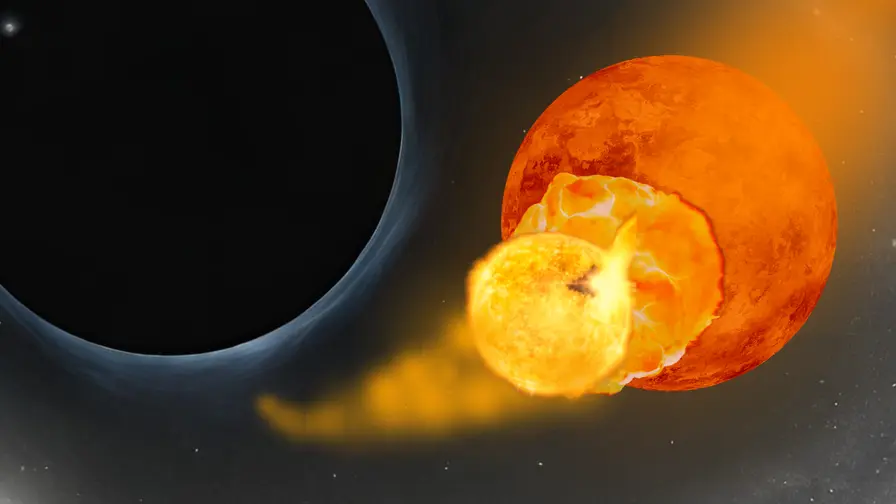
One key process KISS-SIDM helps to model is gravothermal collapse. Unlike typical gases that cool as they lose energy, self-gravitating systems can grow hotter in their centers while shedding energy outward. In SIDM halos, collisions carry heat outward, causing the core to contract, get denser and hotter, and potentially drive runaway collapse over cosmic timescales.
This counterintuitive behavior—gravity producing heating rather than cooling—has major implications. If the inner core undergoes gravothermal collapse, it could accelerate central mass concentration and even seed compact objects or black holes under the right conditions. But mapping the full pathway from a cored halo to a collapsed core has been computationally challenging until now.
KISS-SIDM: bridging the simulation gap
Before KISS-SIDM, researchers typically used separate approaches depending on collision frequency: one for the rare-collision (kinetic) regime and another for the frequent-collision (fluid) limit. The intermediate regime—where collision rates are moderate—lacked a unified, efficient mapping. KISS-SIDM fills that gap with a fast, accurate algorithm that handles a wide range of densities and interaction strengths. The code is publicly available, enabling the community to explore diverse SIDM models and initial conditions.
Technical advantages
- Fast evaluation across regimes from collisionless to strongly interacting.
- Improved accuracy in tracking heat transport and central density evolution.
- Open-source availability promotes reproducible studies and model comparisons.
Black hole seeds and observational prospects
One exciting outcome of better SIDM modeling is refining expectations for black hole formation. If gravothermal collapse pushes central densities high enough, halos could form compact objects or seed black holes earlier or differently than predicted by baryonic processes alone. Observational signatures might appear in the demographics of central black holes, star formation histories, or in precise measurements of halo density profiles using stellar dynamics and gravitational lensing.

Looking ahead, KISS-SIDM offers a practical tool to connect fundamental particle properties with astrophysical observables. As simulations paired with new survey data—such as deep imaging and kinematic studies—become available, scientists will be better positioned to test whether dark matter is truly self-interacting and how those interactions sculpt the visible universe.








Leave a Comment
Comments (2)
Seems promising, but is the intermediate regime really captured? KISS-SIDM sounds neat but i wanna see comparisons with full N-body runs...
wow, if SIDM seeds black holes early that flips a lot of ideas. Need more sims and obs to verify. Excited but cautious.