
5 Minutes
Something extraordinary washed up on the detectors at the bottom of the Mediterranean Sea: a neutrino so energetic it forced physicists to ask whether a tiny, ancient black hole just detonated. Short answer: maybe. The longer answer is messier, more interesting, and the kind of puzzle that keeps scientists awake at night.
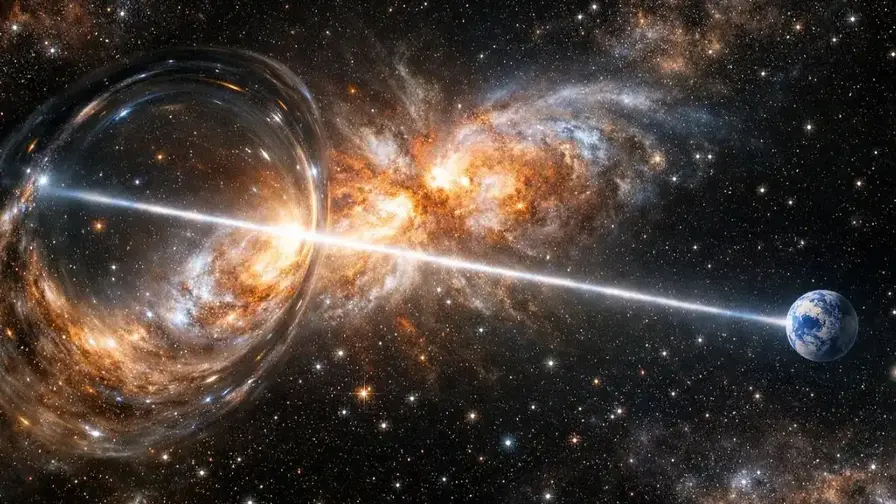
In 2023 the KM3NeT observatory recorded an unusually powerful particle, cataloged as KM3-230213A. This neutrino carried energy in the petaelectronvolt range—orders of magnitude beyond the steady trickle of low-energy solar neutrinos and above what human-built accelerators can reach. A single ghostlike particle, traveling practically unimpeded across cosmic distances, could be the fingerprint of an exotic astrophysical event.
What was seen and why it matters
Neutrinos are notoriously shy. They slide through matter so readily that catching one requires instruments the size of seas and ice sheets. KM3NeT, slung beneath the Mediterranean, is tuned to spot the faint flashes produced when a neutrino finally interacts. KM3-230213A was exceptional not only in energy but in the questions it raises: what astrophysical engine can accelerate—or produce—a neutrino at 100+ PeV?
Scientists have a short list of familiar suspects: gamma-ray bursts, active galactic nuclei, colliding black holes, and pulsar-driven flares. None of these explain everything about KM3-230213A. So a group of theorists turned to a less conventional candidate—primordial black holes (PBHs)—and proposed a mechanism that hinges on Hawking radiation and a subtle quantum twist.
Primordial black holes, Hawking radiation, and a final burst
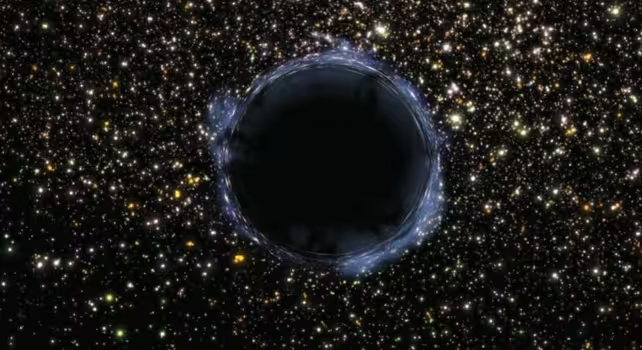
Primordial black holes are hypothetical. Unlike stellar black holes, which form from dying stars, PBHs could have condensed from extreme density fluctuations in the infant Universe, moments after the Big Bang. They would be tiny compared with stellar remnants—perhaps microscopic by everyday standards—but still unimaginably dense.
Stephen Hawking showed that black holes aren’t entirely black: quantum effects let them emit particles, a process known as Hawking radiation. For massive black holes this emission is negligible; for very small black holes it can be intense. As a PBH loses mass, it grows hotter and emits more, eventually entering a runaway phase that ends in a rapid, energetic evaporation. That terminal burst is the theoretical spark that could seed ultra-high-energy neutrinos.
The recent study published in Physical Review Letters suggests that some PBHs might carry an additional property—a so-called dark charge—preventing them from evaporating in the same way as uncharged PBHs. These quasi-extremal PBHs linger in a metastable state and only sporadically blow up in a final, violent flash. During that flash, standard particles and hypothetical heavy species could be produced in abundance, including neutrinos with PeV energies.
Why KM3NeT saw it, but IceCube didn’t
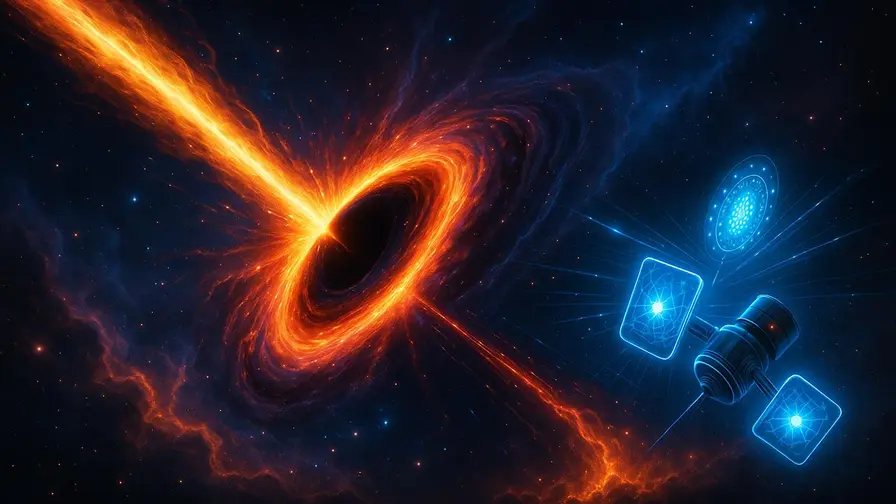
There’s a puzzle embedded in the data: IceCube, the long-running neutrino array at the South Pole, has monitored the sky for two decades and recorded several multi-PeV events, but it did not register anything comparable to KM3-230213A. Some of that discrepancy comes down to instrument sensitivity and energy windows. IceCube and KM3NeT are optimized differently; IceCube’s practical sensitivity tapers at higher energies. If PBH explosions are rare and directional, and if they favor energy bands where Mediterranean sensors excel, KM3NeT might catch what IceCube misses.
The researchers behind the quasiextremal PBH model argue that a population of dark-charge PBHs undergoing sporadic terminal bursts could produce the handful of observed PeV-scale neutrinos without violating other astrophysical constraints. In their picture, these PBHs aren’t constantly screaming into the cosmos; they flare infrequently but dramatically, producing a cascade of particles in a final second that momentarily lights up detectors tuned to the right energies.
Implications and alternative explanations
If PBH evaporation is responsible, the implications are profound. We would have direct observational evidence for black holes formed in the early Universe, a new channel for producing high-energy particles, and an empirical handle on Hawking radiation. It would also hint at physics beyond the Standard Model—dark-sector particles, heavy charged states, or other exotic species emitted during the burst.
Yet extraordinary claims demand careful cross-checks. Other explanations remain viable: transient astrophysical sources we don’t yet understand, statistical flukes, or novel particle physics in active galactic nuclei. The absence of a coincident gamma-ray or electromagnetic signature complicates the picture. A PBH burst could produce many particles that never interact electromagnetically, while conventional sources often light up across multiple bands.
Observational strategy and future prospects
Testing the PBH hypothesis will require coordinated observations. Continued operation and upgrades to KM3NeT, IceCube, and next-generation detectors will broaden energy coverage and improve pointing accuracy. Multi-messenger campaigns that couple neutrino alerts with gamma-ray, X-ray, and optical facilities can quickly rule in or out conventional transient sources. Theoretical work must also refine burst spectra from quasiextremal PBHs so observational teams know what to look for.
Expert Insight
"A single PeV neutrino is a breadcrumb, not a map," says Dr. Lina Ortega, an astrophysicist at the Institute for Cosmic Studies. "But the breadcrumb points somewhere interesting. If primordial black holes are involved, we’re seeing physics that connects the earliest moments of the Universe to particle processes we can test today. That would rewrite a few chapters of cosmology—and that’s why we keep poking at this problem."
Validation requires patience and more events. Rare, high-energy phenomena demand observation time measured in years—and sometimes decades. Still, each new detector and every incremental improvement in sensitivity increases the odds of catching the next flash.
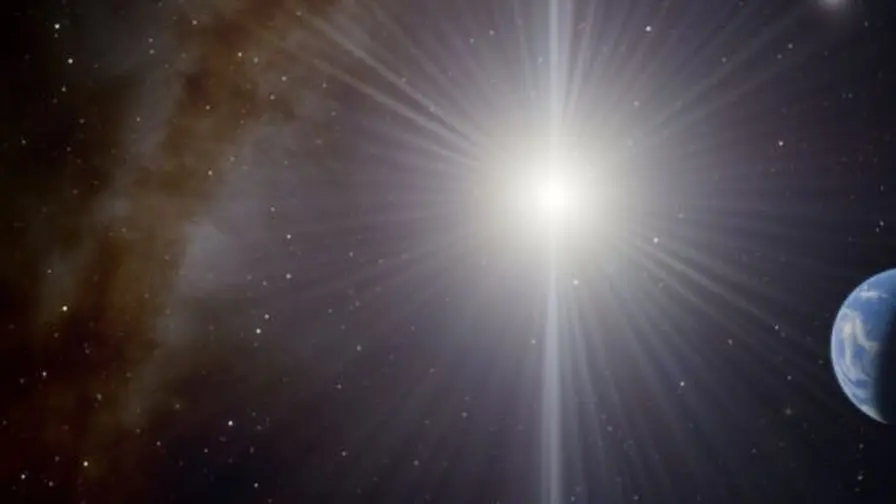
Whether KM3-230213A is a signal from a dying primordial black hole, a novel astrophysical engine, or something even more unexpected, it demonstrates how a single particle can provoke a cascade of ideas. The hunt for the next PeV neutrino is on, and with it the chance to glimpse physics from the Universe’s earliest seconds.







Leave a Comment
Comments (2)
Kind of skeptical here, is this even true? KM3NeT saw one, IceCube didnt, seems odd. Could be a fluke or detector bias tbh, need more events..
Wow a petaelectronvolt neutrino? mind blown. If primordial black holes are even partly responsible, that's wild, but why no gamma rays, why no other signs.. if that's real then…