

5 Minutes
Imagine stepping into winter and feeling your skin flare as if it were being stung. Pain. Itchy red plaques. Swelling that climbs from a finger to an entire limb. For a small but significant number of people, cold exposure does more than cause discomfort; it prompts the immune system to overreact in ways that can be unpredictable and, in rare cases, life threatening.
What cold urticaria looks like and why it matters
Cold urticaria, sometimes called cold allergy, is a condition in which contact with low temperatures provokes hives, swelling, and in severe cases, systemic reactions such as anaphylaxis. The skin reaction can appear while the skin is cold or as it warms back up. Triggers vary widely: winter air, holding ice, swimming in cold water, or even drinking a chilled beverage. Symptoms can range from brief localized wheals to generalized reactions that require emergency treatment.
The disorder is rare but far from trivial. Epidemiological studies estimate about six cases per 10,000 people, though underdiagnosis is likely because mild forms go unrecognized, especially in regions that never see freezing temperatures. Women are affected almost twice as often as men, and the condition most commonly begins in the early twenties, though onset can occur at any age.
Biology at the center of the flare: mast cells and histamine
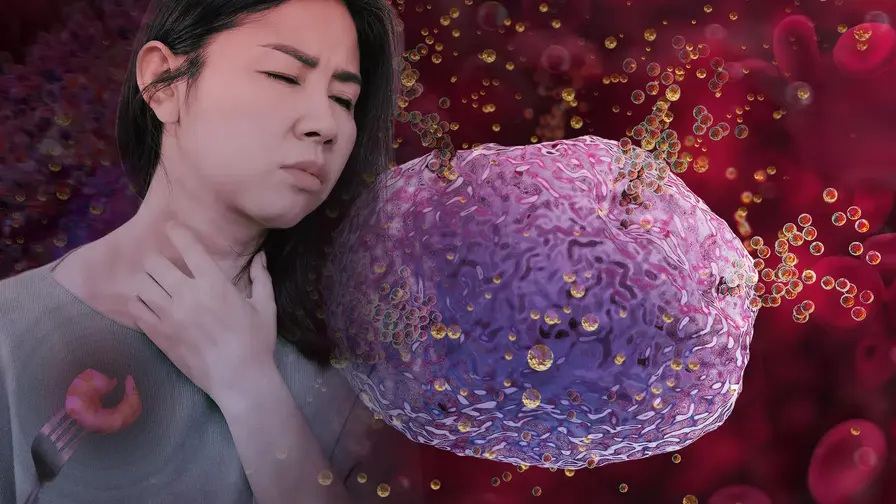
At the heart of cold urticaria are mast cells, immune sentinels that live in skin and other tissues. When triggered, they dump histamine and other mediators into surrounding tissue. Histamine dilates blood vessels and increases their permeability. The result is redness, swelling, itching. When this reaction becomes systemic, blood pressure can drop, airways can tighten, and anaphylaxis may follow.
Why cold activates mast cells in certain people remains an active area of research. Primary cold urticaria, which accounts for about 95 percent of cases, usually has no identifiable external cause. Secondary cold urticaria, the remaining 5 percent, is associated with infections or diseases like Epstein-Barr virus, hepatitis C, HIV, and certain lymphomas. Rare genetic syndromes can produce cold-triggered symptoms too, but these are exceptional.
One plausible hypothesis is that cold exposure alters proteins or cell membranes in a way that creates so called autoallergens, prompting the immune system to attack self rather than foreign invaders. But the chain of events linking temperature change to mast cell activation is not yet fully mapped, and further immunology studies are needed.

How clinicians confirm the diagnosis and measure risk
The simplest diagnostic test is also the most direct: an ice cube is applied to the forearm under medical supervision. If a hive forms where the ice touched the skin, that is diagnostic. This test must be performed in a controlled setting since roughly one in five positive tests can precipitate systemic reactions including anaphylaxis.
After diagnosis, clinicians may quantify sensitivity using two measures. The cold stimulation time test records how long it takes for a visible hive to form when the skin is chilled; a shorter time indicates higher reactivity. The critical temperature threshold determines the warmest temperature that still triggers a response. These measures help guide practical advice: how aggressively someone must avoid certain exposures and whether they should carry emergency medication.

Cold foods can trigger the condition.
Treatment options from antihistamines to biologics
Management begins with avoidance and preparedness. Antihistamines are the foundation of therapy and can reduce itch and swelling by blocking histamine receptors. For many patients, standard doses suffice, but up to four times the usual dose may be required to control symptoms. Increased dosing must be supervised, because some antihistamines cause sedation and other side effects.
About 60 percent of people respond well to antihistamine therapy. For short-lived flares, a brief course of corticosteroids may help, though long term steroid use carries significant risks including weight gain, mood changes, and gastrointestinal effects. For patients whose disease remains uncontrolled, targeted biologic therapy has reshaped care: omalizumab, a monoclonal antibody that neutralizes immunoglobulin E, has shown benefit in severe or refractory cases.
Desensitisation, a stepped exposure to cooler temperatures over hours or days, has been trialed in small studies with some success; it is not yet a universally accepted therapy, but it offers hope for select patients. In emergency situations, intramuscular adrenaline remains the lifesaving intervention for anaphylaxis, though evidence suggests epinephrine auto-injectors may be under-prescribed for people with cold urticaria.

Most people with cold urticaria respond to antihistamines.
Special risks and practical advice
Certain situations amplify danger. Swimming in cold water can cause rapid, systemic histamine release leading to fainting or drowning. Surgical procedures bring additional risk because anesthesia and cool operating rooms can lower core temperature; perioperative warming protocols are important for known patients. Occupational exposures and recreational activities should be reviewed with an allergist or dermatologist to tailor simple mitigation strategies such as insulating gloves, warm wraps, or avoiding direct contact with ice.
There is good news. Longitudinal data show that between a quarter and a half of patients experience partial or complete remission over time. That means careful diagnosis, education, and management do more than control symptoms; they buy time until a proportion of people may outgrow the sensitivity.
Expert Insight
Dr. L. Maria Jensen, clinical immunologist and allergy specialist, notes that the condition is often underestimated. She says: I see patients who have internalised the idea that the cold is simply something to tolerate. Once we identify the trigger and provide a plan, many return to normal life with a few sensible precautions. For a minority, more intensive therapy like omalizumab is transformative and can restore safety and function.

The biological mystery is also an invitation. Unraveling why cold, a neutral environmental factor, turns a helpful immune reaction into a harmful one could reveal pathways relevant to other allergic and autoimmune disorders. That kind of mechanistic insight may lead to better, more precise therapies in the years ahead.
If you or someone close to you develops hives after exposure to cold, seek specialist evaluation. Simple testing can clarify risk and point to effective interventions that let people live without fear of a season or a swim turning into a medical emergency.









Leave a Comment
Comments (2)
Hmm is this even common? 6 per 10k sounds low, or are docs missing a bunch of cases? if that's true, alarming
wow didnt know cold could trigger that much... makes me nervous about winter swims, the ice cube test sounds kinda scary, yikes