
4 Minutes
They’ve found a shortcut. Instead of tending rows of Withania somnifera, researchers have taught common baker's yeast to churn out the molecules long credited with ashwagandha’s calming effects.
For centuries ashwagandha has been steeped, powdered and prescribed in South Asian medicine. Lately the shrub's root extracts have exploded onto global shelves as sleep aids, stress remedies and trendy “wellness” boosters. The active chemicals people point to are a class of steroidal lactones called withanolides. Extracting them from roots, however, is slow, land-intensive and variable from crop to crop.
So a team led by bioengineers flipped the manufacturing problem: if you can read the plant’s recipe, why not hand it to an organism that grows fast and does fermentation at industrial scale? They sequenced the ashwagandha genome, hunted for the genes that build withanolides, and then moved a set of those genes into Saccharomyces cerevisiae — ordinary yeast.
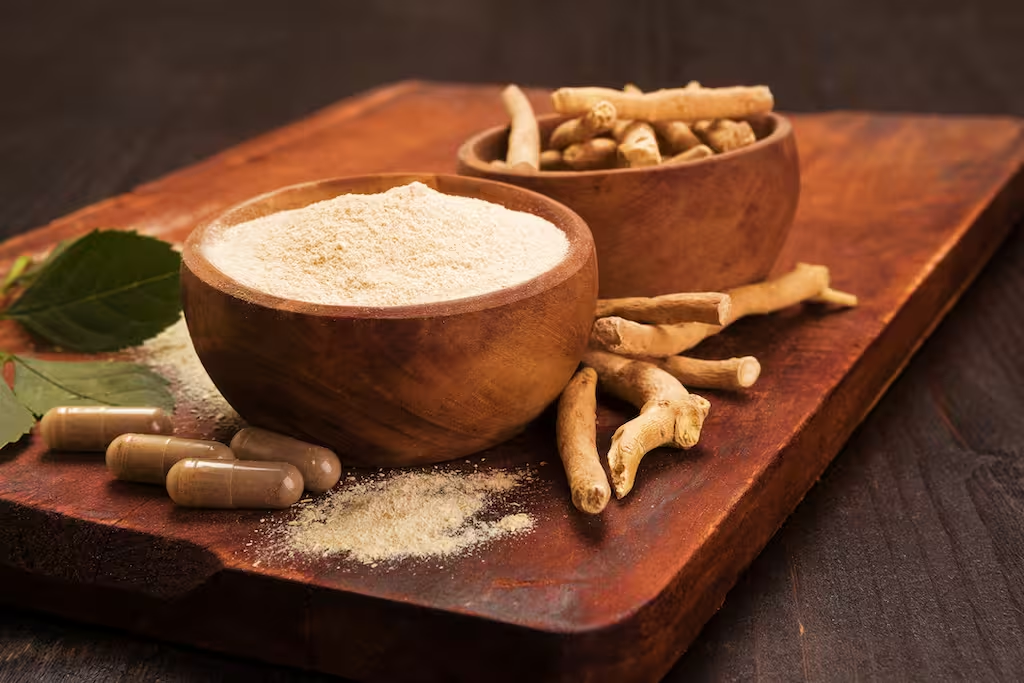
Withanolide compounds are found in the roots of ashwagandha.
It worked. Not perfectly. But it worked. When six plant genes were stitched into the yeast genome, the microbes began assembling withanolide molecules within days. The concentrations reported so far are in the milligrams-per-liter range — low for a finished drug but a clear starting line for optimisation.
From genome to fermenter: how the pieces fit
Sequencing revealed clusters of enzymes that act like an assembly line inside the plant. The researchers identified six key enzymes and encoded them into yeast chassis. Yeast and plants split evolutionary paths about a billion years ago. Still, when the molecular parts were introduced into the microbe, the biochemical machinery accepted them and the pathway came alive.
"We not only discovered the pathway through this yeast engineering approach, but by the end of this paper we have a prototype yeast strain that can be industrialized to produce withanolides," says Jing-Ke Weng, the study’s corresponding author and a bioengineer at Northeastern University. "We were actually very surprised it worked."

What the team achieved is at once practical and permissive: practical because yeast can be grown quickly in controlled tanks, and permissive because a microbial system makes it easier to tweak which exact withanolide analogs are produced. That matters. Different analogs can have distinct biological effects and safety profiles.
Right now the yields are modest. But the pathway is defined. That opens routes familiar to synthetic biologists: enzyme engineering, promoter tuning, metabolic balancing and fed-batch fermentation to push titers from milligrams per liter toward commercially relevant levels.
Implications for medicine, industry and research
Scaling microbial production could change how supplement companies source active ingredients and how researchers test therapeutic claims. Many consumer products already advertise ashwagandha for anxiety reduction and better sleep. The strongest clinical signal among published studies suggests a modest anxiolytic effect, but trials are mixed and side effects — nausea, diarrhea and, at higher doses, liver toxicity — are real concerns.
Producing pure withanolide variants in a lab rather than extracting crude root preparations has several advantages. Dosage control improves. Safety testing becomes clearer. And medicinal chemists can explore structure–function relationships faster if they can order gram quantities of single molecules rather than milligram scraps from plant extracts.
There are broader environmental and agricultural angles too. If microbial biosynthesis reduces pressure on land use, it could ease the ecological footprint of rising demand for herbal products. But any shift raises regulatory questions: how will supplements or drugs derived from engineered microbes be labeled? Which agencies will oversee scale-up, containment and quality?
Expert Insight
"This is exactly the kind of leap synthetic biology promised: take a complex plant pathway and rehome it in a system optimized for production," says Dr. Maya Patel, a fictional but realistically framed synthetic biology researcher and science communicator. "The technical hurdles now are classic scale-up problems—boosting flux through the pathway and ensuring product stability. If those are solved, researchers will be able to test therapeutic efficacy with far better materials than before."
Publishing in Nature Plants gives the work visibility and invites other labs to try alternative optimisations. The reported system is a prototype: a scaffold to iterate on, not a finished factory. Yet even as a proof of concept it nudges open doors for drug discovery, safer supplementation and more rigorous clinical research into ashwagandha’s many claimed benefits.
How fast that future arrives depends on science, industry and regulation moving in concert. For now, the yeast strains sit in the pages of the journal and in the minds of engineers plotting the next round of improvements — the kind of momentum that turns an old herbal remedy into a modern, testable compound.












Leave a Comment
Comments (2)
Whoa, microbes making ashwagandha stuff in days? That's wild and kinda awesome, but also weird to think of yeasts brewing herbal meds lol
Doesnt this raise patent and safety questions? If yeast can pump out withanolides at scale, who labels it supplement or drug, who checks purity, and what about escape or contamination risks... if that happens it's messy