

5 Minutes
What if the next breakthrough idea arrives while you are asleep? It sounds like science fiction, but a recent lab study at Northwestern University suggests dreams can be coaxed to carry hints that nudge waking insight—and that the sleeping brain may be more malleable than we thought.
Researchers have long told people to "sleep on it." Intuition and anecdote backed that advice, but experimentally steering dreams proved difficult. Dreams are slippery. Wake a sleeper and you lose the thread. Play a cue too loudly and you break the sleep stage. The Northwestern team used a careful blend of sound cues and sleep monitoring to sidestep those problems and test whether dream content can be nudged to include unresolved problems.
How the experiment worked
The study recruited 20 volunteers, all with prior lucid-dreaming experience, and exposed them to a battery of difficult puzzles. Each puzzle was paired with a distinct soundtrack. Participants had only a few minutes per puzzle, so most remained unsolved by morning. Overnight, the volunteers slept in a monitored lab while polysomnography recorded brain waves, eye movements and other physiological signals to identify REM sleep—the stage most closely associated with vivid dreaming and occasional awareness within the dream.
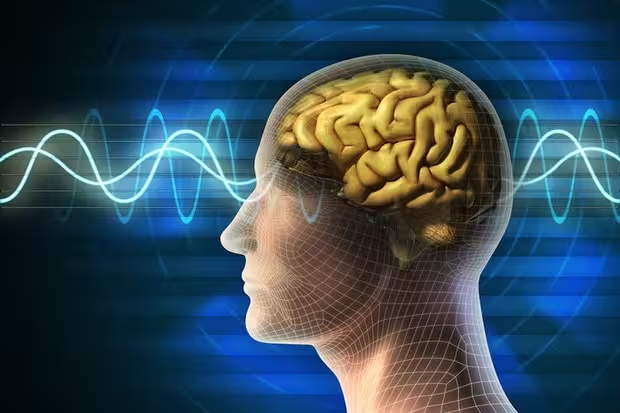
During REM periods, researchers used targeted memory reactivation (TMR): short sound cues linked to particular puzzles were played softly after the EEG showed stable REM patterns. Some dreamers had practiced simple dream signals—like a patterned sniff—so they could indicate in-dream recognition without waking. The outcome was subtle, but measurable. Roughly three-quarters of participants later reported dreams containing elements tied to the cued puzzles. And when a problem appeared in dream content, it was solved after waking at a higher rate than problems that did not appear in dreams (about 42% versus 17%).
Dig into the numbers and nuance appears. In a subset of 12 participants who seemed especially responsive to cues, reactivated puzzles went from a roughly 20% baseline solve rate to about 40% after dreaming cues were presented—doubling the odds in that group. These are promising signals. They are not, however, proof that dreaming directly generates solutions. Motivation, heightened attention to the puzzles, or the mere act of replaying memory traces could account for some of the effect.
Why this matters for creativity and cognition

At stake is more than curiosity about dreams. If REM activity can be guided to favor particular memories or problems, sleep becomes an arena for deliberate cognitive work—what some researchers call "sleep engineering." That has implications across cognitive neuroscience, education and mental health. Imagine controlled reactivation of learning content to strengthen weak memories, or the use of cues to help process emotionally charged events. The Northwestern team frames this as an initial step: a demonstration that dream content is not wholly random and can be biased by sensory cues delivered at the right moment.
Ken Paller, the study's senior author and a cognitive neuroscience professor, emphasized the potential. He suggests that learning how brains reframe information during sleep could expand our capacity for creative problem solving, and, in the long run, help address complex challenges that demand innovation. Karen Konkoly, lead author and postdoctoral researcher, said the biggest surprise was how non-lucid dreams—those in which participants were not consciously aware they were dreaming—still incorporated the sound cues in imaginative, sometimes metaphorical ways. One participant dreamed of walking through a forest after hearing a cue tied to a "trees" puzzle. Another dreamer found herself fishing in a jungle when a jungle puzzle was cued.
Expert Insight
"This study is a technical and conceptual stepping stone," says Dr. Maya Rivers, a fictional cognitive neuroscientist who studies sleep and learning at a major research university. "Targeted memory reactivation shows us that sleep is not a passive state but a dynamic substrate for rearranging information. The real challenge ahead is scaling these methods to diverse populations and learning domains, and teasing apart whether cues spark creativity directly or simply prime the mind to notice solutions on waking."
Her point speaks to the core limitation: small sample size and the specific recruitment of lucid dreamers leave open questions about generalizability. TMR requires precise timing and careful monitoring—conditions not easily reproduced outside a lab. Still, the evocative dream reports and measurable gains in problem solving argue that the sleeping brain can be provoked in lawful ways.
Implications, ethics and next steps
Researchers plan to test whether similar approaches can aid emotional processing, consolidate different types of learning, or be applied without prior lucid-dream training. There are important ethical and practical considerations. Who controls the content of these cues? How do we prevent inadvertent distress when reactivating emotionally charged experiences? And what are the limits of nudging mental content without compromising autonomy?
Future work will need larger, more diverse samples and protocols that compare TMR effects across sleep stages, not only REM. The technology—wearable sleep trackers with robust REM detection, quieter cue delivery systems, and algorithms that identify optimal cue timing—will play a key role. If the findings hold, sleep could become a tool for creativity, learning and emotional resilience rather than merely a passive respite.

The study does not deliver a ready-made recipe for engineering genius. But it nudges open a door. If we learn to knock without waking the house, we may discover a new workshop where ideas are quietly assembled while the lights are out.












Leave a Comment
Comments (2)
is this even true? tiny sample, lucid dreamers only. maybe cues just prime attention. curious if normal folks get same boost.. quick thought
wow, didn't expect dreams could be steered like that. kinda eerie but exciting, idea of a midnight workshop is wild. if real, this could change creativity or be a privacy nightmare lol