

2 Minutes
One brief exercise shifted brain connectivity. That’s not speculation. It’s what researchers observed. Scientists who tested a targeted speed-training task found measurable changes in how regions of the brain communicate. The effect was specific: the benefit showed up for that exact exercise protocol and cannot be taken as a blanket endorsement of all brain-training apps or games. Still, the result matters. Very much.
What the study revealed and why it matters
The team behind the work, led by a researcher named Albert, says the next step is figuring out the mechanism — the biological how and why. Decode that, and you could design exercises that are deliberately more effective at strengthening cognitive networks. Right now we have a promising signal. The mechanism remains a mystery.

Why pursue this? Because the stakes are enormous. Dementia affects roughly 57 million people worldwide and ranks as the seventh leading cause of death, according to the World Health Organization. A modest reduction in incidence in the United States — say, a 25 percent decline — could potentially cut patient-care costs by about $100 billion. That kind of impact turns an academic finding into public-health priority.
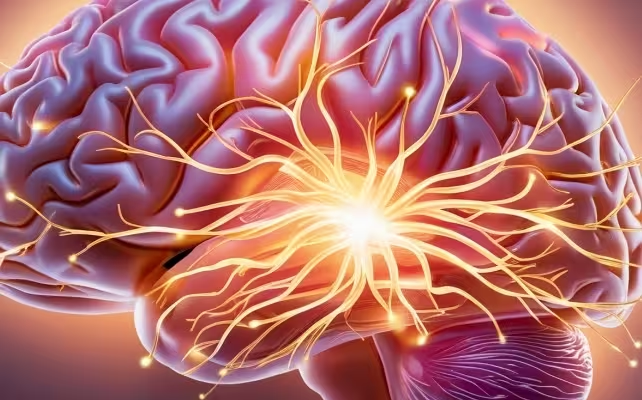
Is this a cure? No. Is it a research avenue worth following? Absolutely. The authors are careful. They stress the limited scope of their findings and warn against assuming one positive result applies to all cognitive-training products. Still, discovering how a short speed exercise changes neural traffic could point scientists toward new, scalable interventions that slow cognitive decline.
Questions remain. But if a simple training tweak can tune network dynamics in the brain, why not explore it — rigorously, deliberately, and at scale?














Leave a Comment
Comments
No comments yet. Be the first.