
3 Minutes
Look closely and your eyes will play tricks. A bright, compact spiral hugs the rim of a much darker, ragged galaxy. The scene feels intimate. It looks like a close encounter. Yet this pairing is a deception born of perspective.
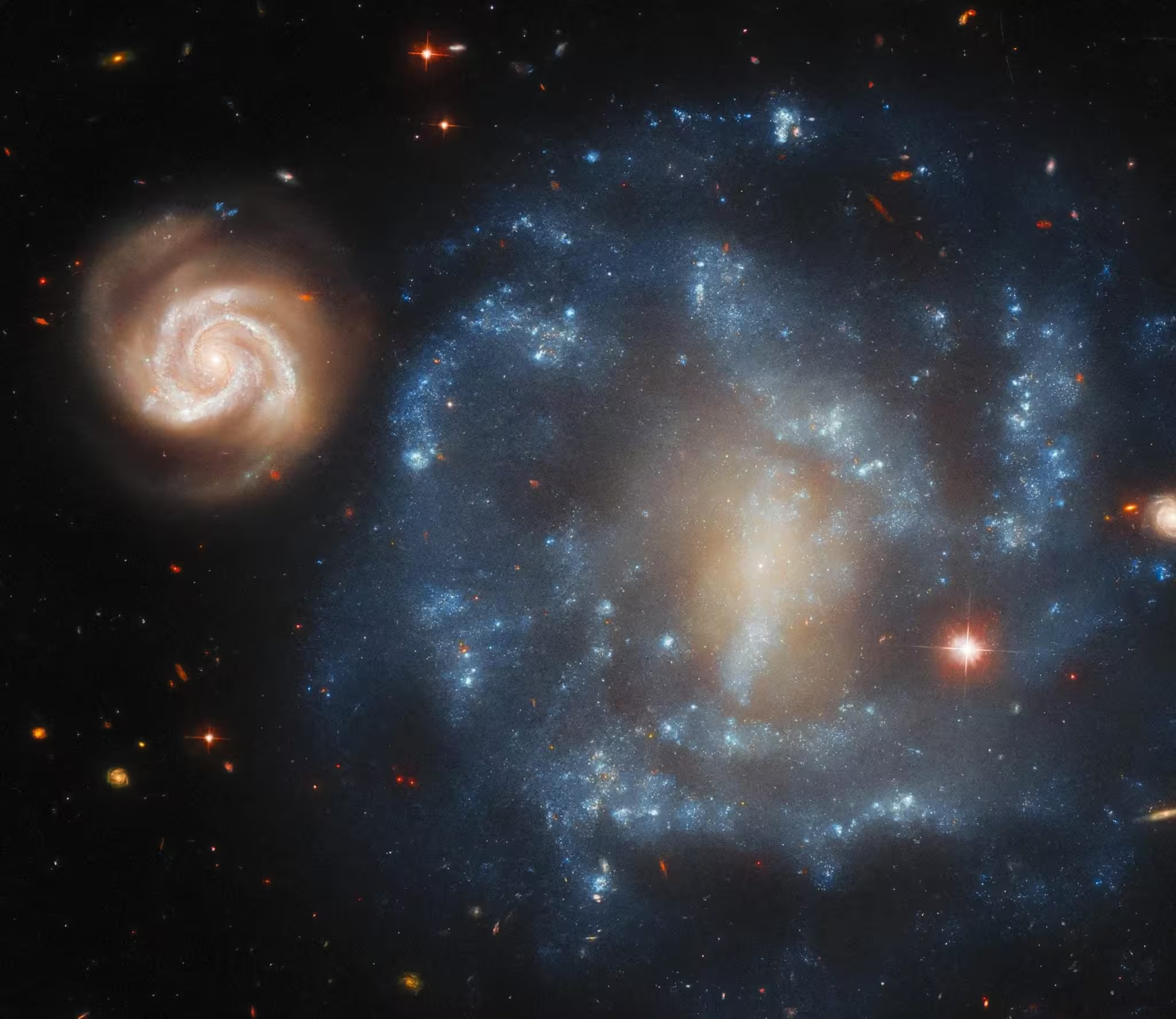
At first glance, this cosmic duo looks like a small, energetic spiral galaxy dancing around a much larger, shadowy companion. But the pairing is a trick of perspective. Credit: ESA/Hubble & NASA, J. Dalcanton, Dark Energy Survey/DOE/FNAL/DECam/CTIO/NOIRLab/NSF/AURA
The objects belong to a catalogue familiar to anyone who studies unusual galactic forms: Halton Arp's Atlas of Peculiar Galaxies. Compiled in the 1960s, that atlas collected bizarre and asymmetrical galaxies so astronomers could puzzle over the shapes and processes that shaped them. Hubble's sharp eye has since revisited many of Arp's entries, revealing textured dust lanes, scattered star clusters, and filamentary arms that once blurred in older photographs.
In this frame, known to cataloguers as Arp 4, the two main targets carry MCG designations. The faint, diffuse component is listed as MCG-02-05-050. It shows a low surface brightness profile: a sprawling disk that lets very little light escape per unit area, so the spiral structure looks shredded and incomplete. Nearby, the luminous partner labeled MCG-02-05-050a appears compact, blue-tinted, and studded with star-forming knots. Energetic. Young. It seems the more spirited of the two.
Why this scene fools us
The trick is simple. MCG-02-05-050 sits roughly 65 million light-years from Earth. MCG-02-05-050a, by contrast, lies at about 675 million light-years — more than ten times farther away. When two objects separated by such vast distances happen to align along our line of sight, the outcome can be spectacular and misleading. A dim giant can masquerade as the background. A distant bright galaxy can appear small and clinging to a nearby halo. Perspective collapses enormous scales into a single, deceptive tableau.
Are these galaxies interacting? No. There's no tidal bridge, no matched distortions that would betray a gravitational embrace. Their velocities and redshifts place them on very different rungs of the cosmic ladder. What Hubble gives us here is an accidental composition — like two birds perched on the same power line, but on different continents.
Why does this matter beyond being a pretty picture? Because images like this sharpen our thinking about how we infer relationships in astronomy. Without distance measures — spectroscopic redshifts, for instance — apparent proximity can mislead. Surveys that map positions and brightness have to be married to velocity and distance information before we can claim physical association. The lesson is practical: never assume that neighbors on the sky are neighbors in space.
Arp 4 also highlights the ongoing hunt for low surface brightness galaxies. These faint giants can be massive yet hard to detect, hiding a record of past accretion events, star-formation history, and dark matter distribution. Advances in wide-field imaging and deeper exposures are now revealing more of these quiet systems, reshaping models of how galaxies grow and age.
Images like this one are invitations. They push observers to measure, to compare, to ask whether what we see is what truly is. The cosmos will keep staging optical illusions — and we will keep learning how to read them.









Leave a Comment
Comments
No comments yet. Be the first.