
3 Minutes
Imagine wandering through a festival ground with no plan, just drifting from stage to food truck. Do you veer left more than right? It turns out you probably do — and not by accident.
Researchers working across Spain and Japan set out to test a question that began as a curiosity during pandemic-era social distancing studies: when left to roam, do humans show a directional preference? The answer, repeatedly and quietly, was yes. A modest but clear tilt toward counterclockwise movement showed up again and again.
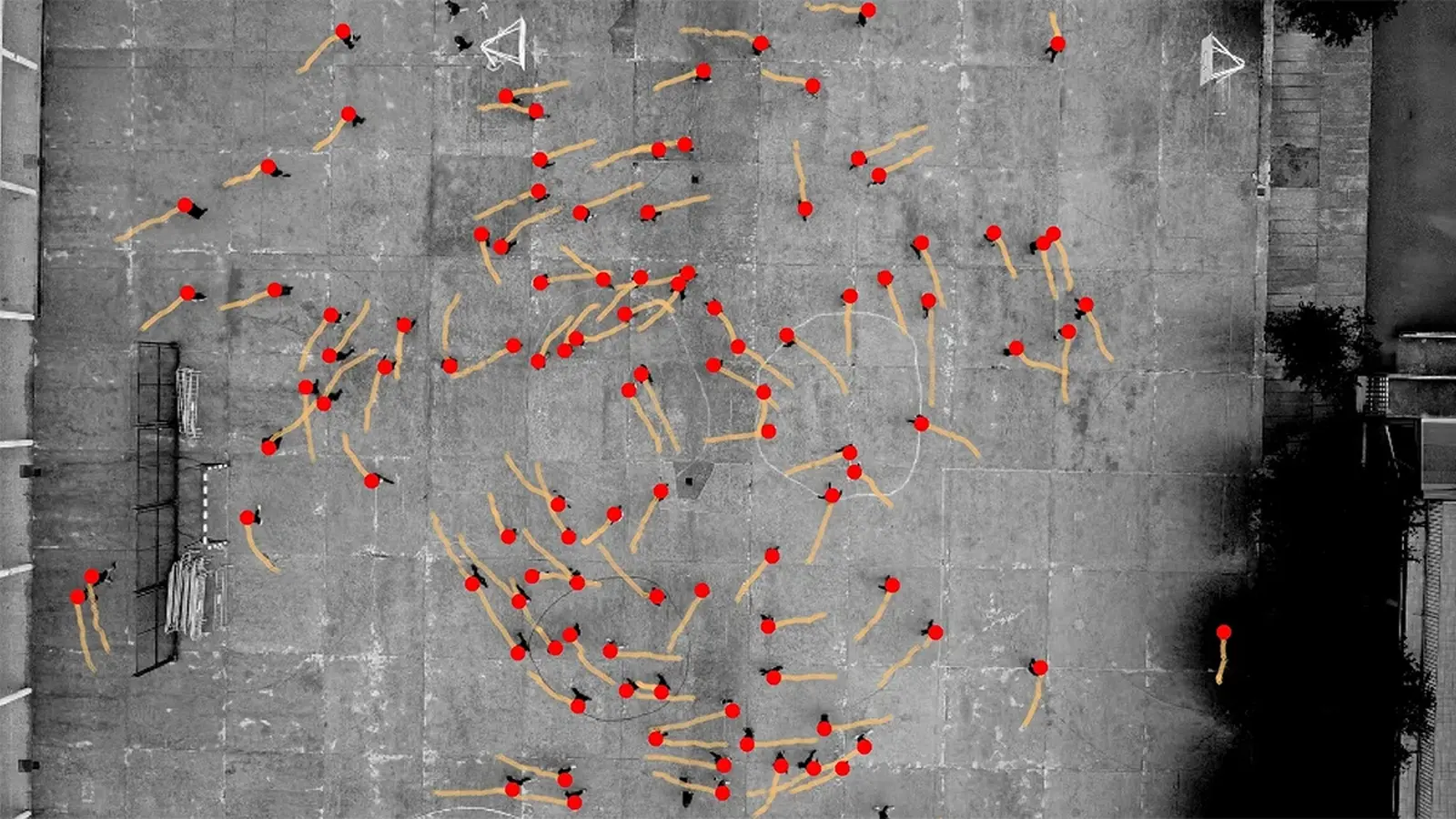
The team ran experiments in different settings and with different people. Enclosed halls, open plazas, groups and solitary walkers: the pattern persisted. One telling setup placed 209 volunteers inside a hexagonal enclosure formed by chairs and tables and asked them simply to walk however they wished. Even in isolation from crowds, the left-leaning tendency emerged.

Experiments were carried out in different countries, with different people, in different settings – and the counterclockwise bias (the dots above the zero line) was consistently present.
It wasn't explained by the usual suspects. Dominant hand or foot? No effect. Biological sex? No effect. Patch one eye and the bias remains. Age mattered a little — younger participants tended to turn left more often — but the study didn't include many people past their mid-30s, so how this trait evolves with age remains unknown.
“When people walk without a destination you expect randomness,” says Claudio Feliciani, who led the engineering side of the work while at the University of Tokyo. “Instead we found a measurable counterclockwise bias under many different conditions.”
Why left? The team ruled out large-scale physical forces like the Coriolis effect or Earth’s magnetic field as plausible drivers. Instead the evidence points toward some internal asymmetry — perhaps biomechanical or neural. In plain terms: our bodies or brains may subtly nudge us to favor one turning direction over the other.

Individual tests again showed a counterclockwise bias (the graphs bunching to the right of the neutral zero)
This leftward nudge, modest but consistent, hints at an underlying asymmetry in human locomotion.
The discovery may sound trivial until you consider its practical reach. Architects and emergency planners design flows for airports, stadiums, train stations and shopping centers; every small bias can change how crowds form and how quickly spaces empty in an emergency. Even sporting traditions — many track and racing circuits run counterclockwise — might reflect, or be reinforced by, the same human inclination.
Next steps are already on the table. The team suggests virtual reality experiments to isolate sensory inputs, studies that include older adults and people with mobility differences, and comparative work in animals: a few insect studies have hinted at directional tendencies, but mammals and birds remain largely untested in this context.
Published in Nature Communications, the study reframes an everyday action — the simple choice of which way to turn — as a window into human movement. Small, consistent biases can reveal deep-seated biological patterns. So the next time you drift left through a crowd, take it as more than habit; it might be a subtle echo of how we are built to move.

Leave a Comment
Comments
No comments yet. Be the first.