

5 Minutes
Imagine trying to hear a whisper in a thunderstorm. That is the scale of the problem physicists face when they hunt for faint cosmic signals — traces of dark matter or ripples from the infant cosmos — buried beneath overwhelming instrumental noise.
Researchers at Imperial College London, working within the AION collaboration, have built a tabletop demonstration that flips that problem on its head. By operating two atom interferometers as a paired system and reading them with the same ultrastable laser, they showed that the shared laser noise can be cancelled, leaving the weak, meaningful signal intact.
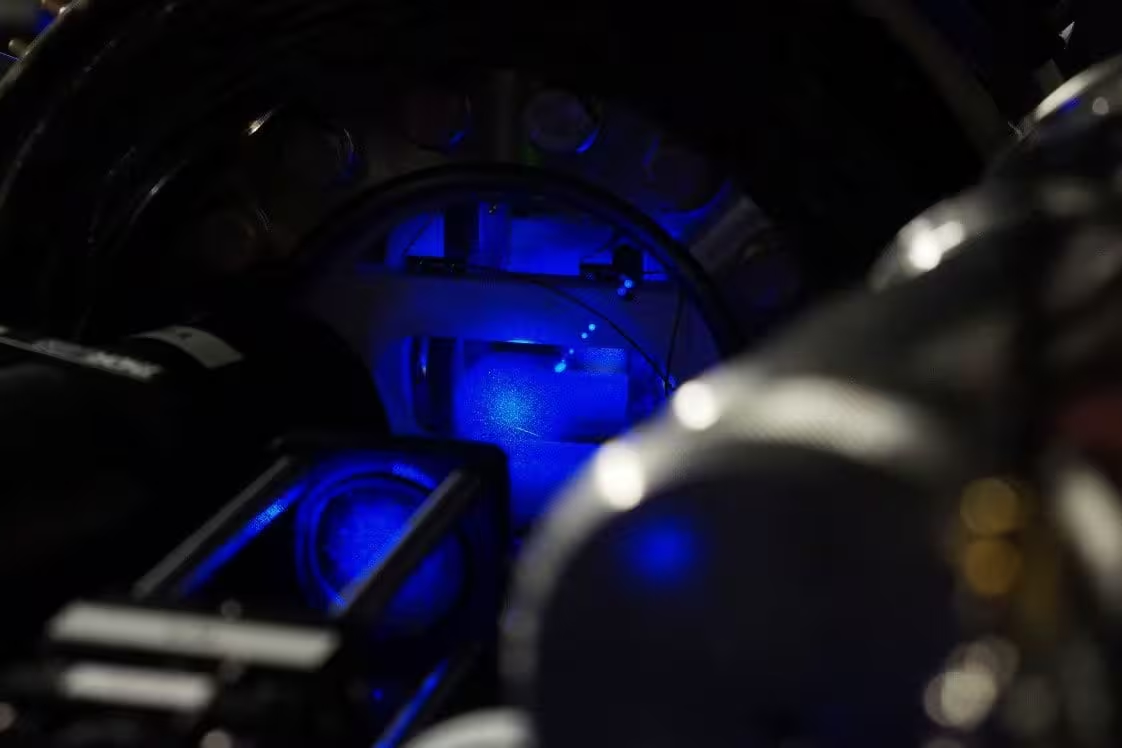
The small glowing ball in the center of this chamber is a cloud of atoms at close to absolute zero, levitating on blue laser light. These atoms will be cooled even further before becoming tiny sensors, turned to listen for gravitational waves and dark matter.
Short sentences now. Big implications next. Atom interferometers split and recombine clouds of ultracold atoms using pulses of light, converting tiny changes in motion into measurable phase shifts. When those devices sit far apart and are interrogated by the same laser, any jitter in the laser imprints the same error onto both measurements. Compare the two. The common error falls away. What remains may be physics.
The Imperial team deliberately broke the experiment to prove the point. They injected far more phase noise than a real clock laser usually produces, swamping each interferometer so that on its own it looked like random static. Yet, when the two outputs were compared, the interference re-emerged and the measurement reached the quantum-limited sensitivity the designers had aimed for.
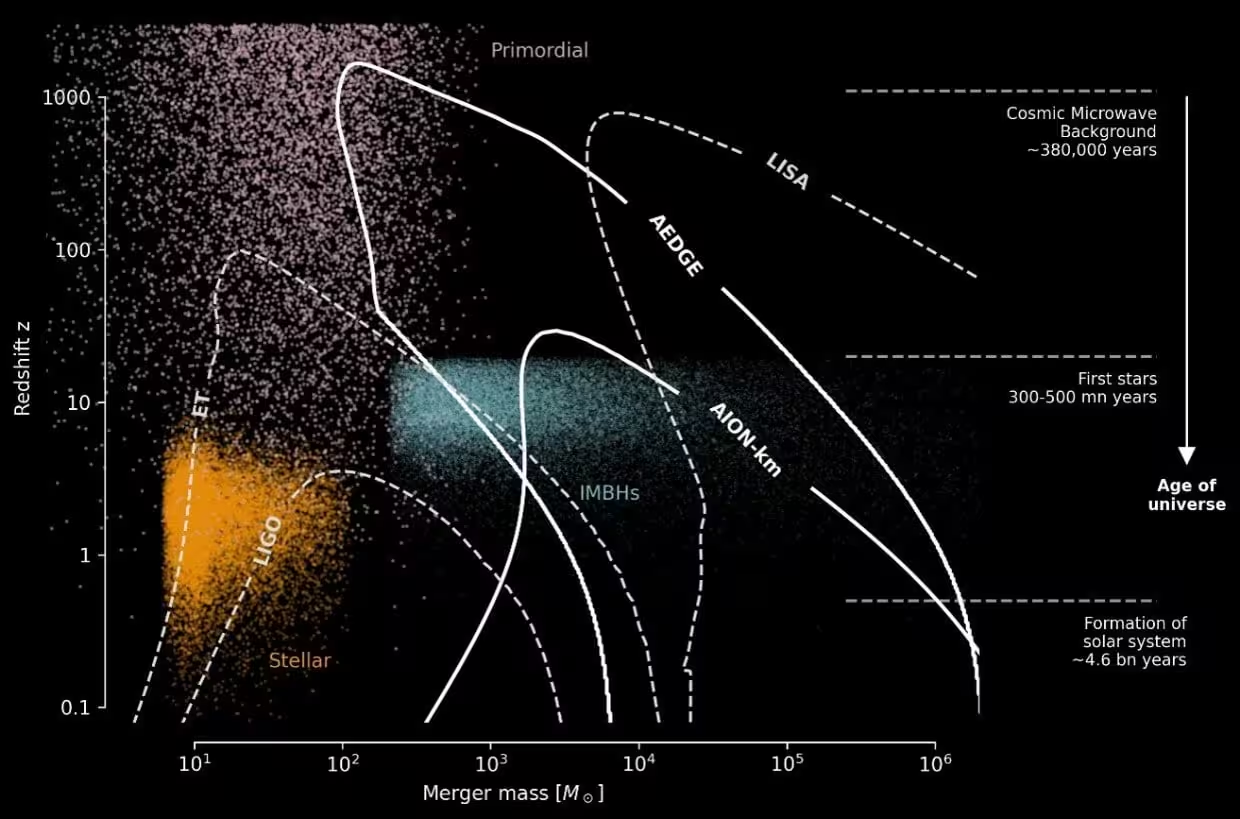
Simulated black hole mergers in the observable Universe, with projected sensitivities of existing and proposed gravitational wave detectors. The new class of atom-based sensors pioneered in this work (AION/ AEDGE) may help us see Intermediate Mass Black Holes (IMBHs) that played a pivotal role in our galaxy’s formation.
The paired-interferometer trick recovered signals that otherwise would have been lost, demonstrating laser noise cancellation under realistic conditions.
To make the test relevant to future facilities, the group used widely separated clouds of ultracold strontium 87 and a single ultrastable clock laser to mimic the challenges expected in long baseline detectors. They even added an oscillating signal that resembled what a passing gravitational wave or a dark matter field might produce. The signature survived. Neither interferometer held useful information alone, but together they exposed the buried waveform.

One of the laser systems used in the Imperial Laboratory to cool atoms and manipulate their quantum state.

Why does this matter beyond a neat laboratory achievement? Because scaling atom interferometers to kilometre baselines is central to proposals aiming to open new windows on the Universe. Long baseline, atom-based sensors could probe gravitational waves at frequencies that current laser interferometers miss, and they offer a new modality to search for exotic dark matter candidates that interact with atoms in subtle ways.
Imperial researchers point to a wider ecosystem of projects that would benefit. The AION effort is allied with MAGIS at Fermilab and proposals such as AICE at CERN, where similar techniques could stretch across far greater distances. Building those facilities will demand high-power lasers that remain exquisitely precise and methods to tame the noise that inevitably grows with scale.

To build a quantum sensor, light must be prepared in a carefully controlled state where its frequency, polarisation, and intensity are all well controlled. Here, the polarization of blue light is altered before it is used to cool the atoms to absolute zero.
There are technical mountains ahead. Generating intense, ultra-pure light and maintaining atomic coherence over long separations are hard engineering problems. But this proof-of-principle removes a major conceptual hurdle: the fear that laser phase noise would swamp any putative cosmic signal in a two-interferometer architecture.

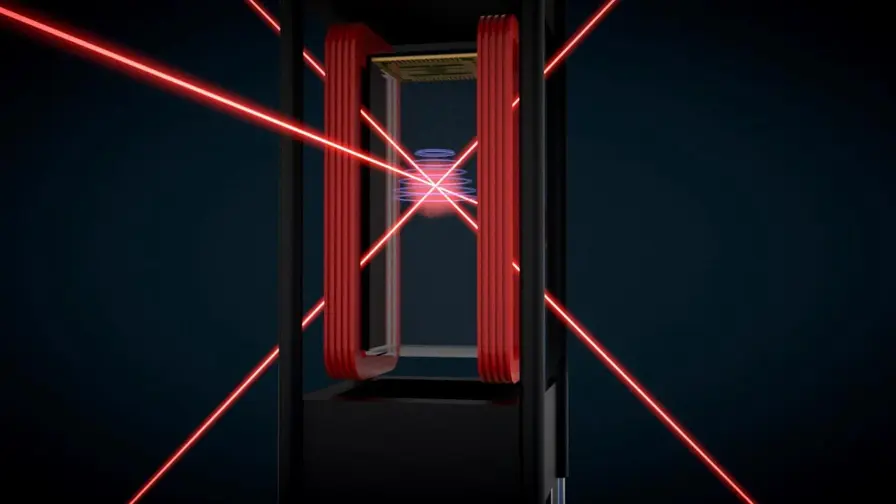
To build a quantum sensor, light must be prepared in a carefully controlled state where its frequency, polarization, and intensity are all well controlled. Here, the frequency of red laser is altered before it is used to cool the atoms to absolute zero.
The Guardians of the lab bench are optimistic. The prototype is small. Yet it shows the principle working under stress. It also suggests a tidy route to combine the sensitivity of atomic clocks with the spatial reach of interferometers, creating detectors that listen in frequency bands presently out of reach.
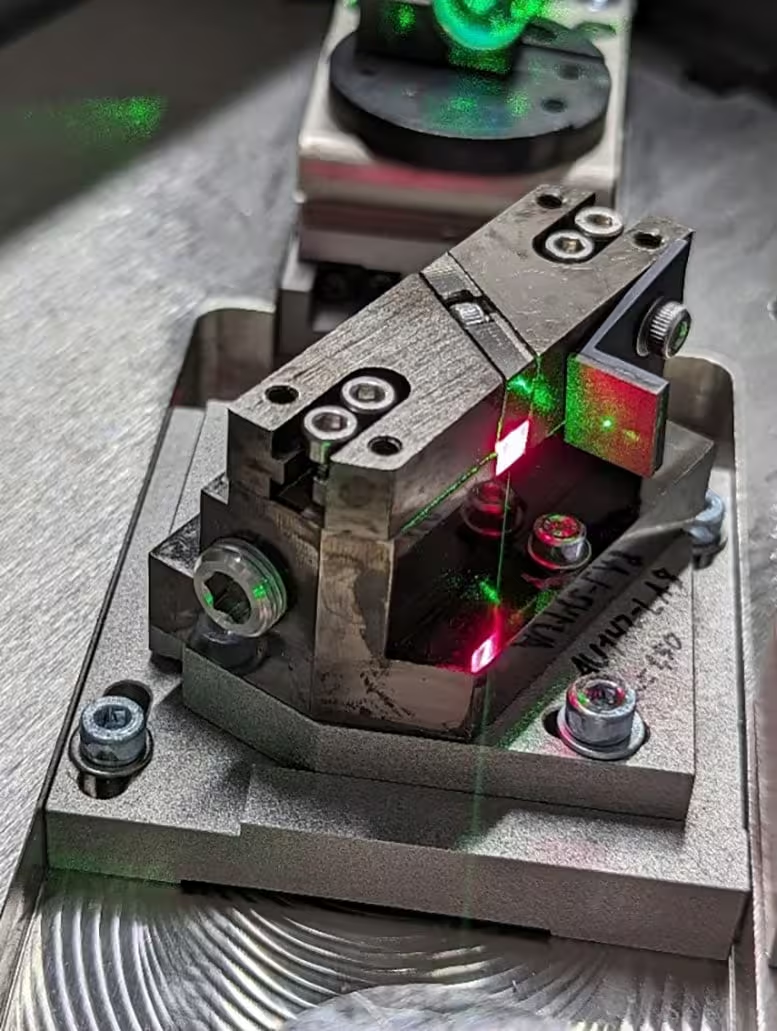
Part of the challenge of building large-scale quantum sensors is generating very high power laser light that is still highly precise in its frequency. This picture shows a titanium sapphire crystal resonating in an optical cavity, generating light that will go on to split the quantum state of our atoms. The red light in this picture is one of the purest lights in existence – it is nothing but red down to the fifteenth decimal point.
So what might we hear, once instruments of this class are built large enough? Possibly the telltale chirp of intermediate mass black hole mergers, or rhythmic oscillations from fields that could be dark matter. Or perhaps nothing familiar at all, just new phenomena that change how we understand matter and gravity.
It is a tidy, human ambition: turn noise into signal, and let the cosmos speak a little louder.











Leave a Comment
Comments (2)
Is this even true? They blasted lasers with fake noise to show cancellation, but km baselines will throw new hurdles, right… if that holds...
Wow, that demo felt like scifi. Noise literally gone, kinda spooky. Hope they can scale it, lots of tough engineering ahead tho!