
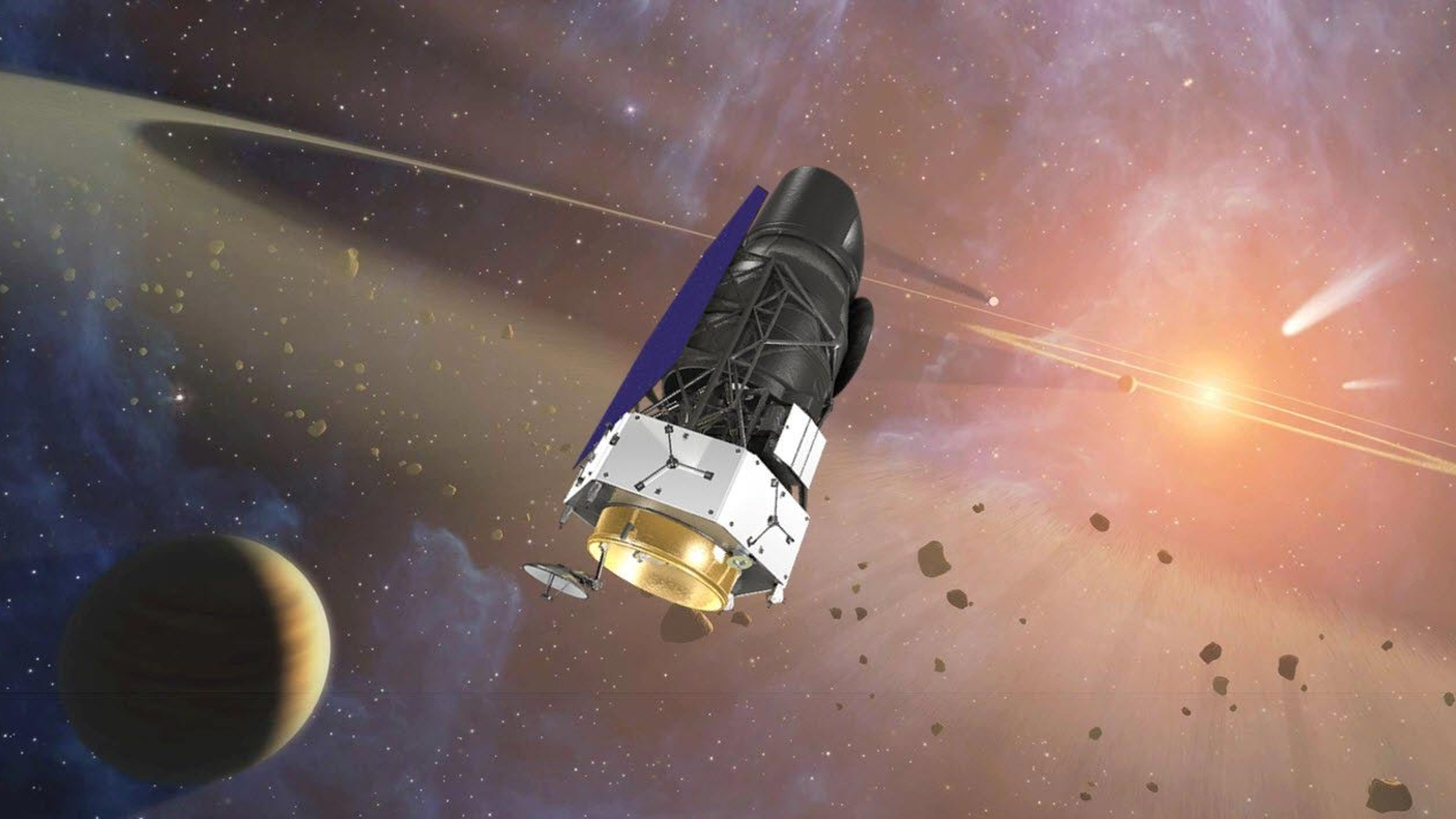
The universe just gained a new kind of wide-angle eye. Quietly, and with engineering the size of poetry, NASA’s Nancy Grace Roman Space Telescope is set to sweep across the heavens in a way Hubble never could: razor-sharp detail stretched across vast swaths of sky.
Roman pairs a mirror the same size as Hubble’s—7.9 feet across—with an instrument built for scale. The Wide Field Instrument sees as deeply as Hubble’s cameras but captures an area roughly 100 times larger in a single shot. The implication is almost dizzying. What took Hubble decades to nibble at, Roman could, in principle, cover for the entire sky at comparable resolution. That is not modest ambition. That is a mapmaker’s revolution.
Instead of peering through a keyhole, Roman will throw open a cathedral’s doors. With that breadth, astronomers expect to find rare objects more efficiently: newborn and dying stars, distant galaxy clusters, the faint scaffolding of dark matter, and worlds hidden in the glare of their host stars.

Roman’s infrared vision also makes it an excellent partner for the James Webb Space Telescope. Webb digs very deep into very small patches of sky; Roman will show where to look and how those deep digs fit into the grander tapestry. Together, they will produce a richer, more connected picture of cosmic history.
At the University of Arizona, faculty and students are gearing up to turn Roman’s torrent of data into discoveries. Two major lines of investigation focus on the universe’s invisible majority: dark matter and dark energy. One team, led by Elisabeth Krause, is developing a technique called kinematic lensing. By combining Roman’s images with spectroscopic measurements, they hope to sharpen estimates of how dark matter is distributed and how dark energy is driving cosmic expansion.
Another group, led by Tim Eifler, is building the computational backbone to translate billions of galaxy detections into physical insight. The mission will produce enormous catalogs containing galaxies near and far; turning those lists into constraints on cosmology requires heavy-duty computing. Eifler’s lab received funding to add high-performance resources to the university’s systems so models can move from raw counts to numbers that describe the universe’s composition.
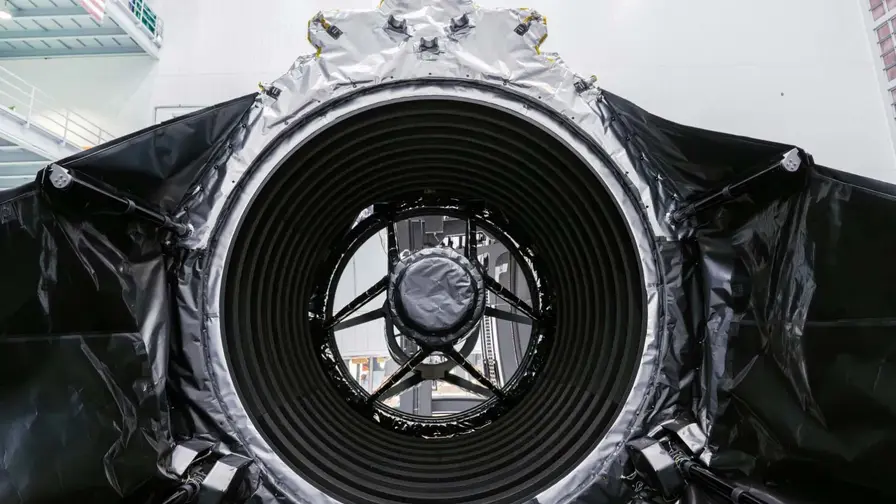
Roman will also test new ways to see exoplanets directly. Its Coronagraph Instrument is a technological tightrope, suppressing a star’s overwhelming light long enough to glimpse a faint companion. Masks, deformable mirrors, and clever filters will try to reveal planets up to 100 million times fainter than their suns—an advance of two to three orders of magnitude over current space-based coronagraphs.
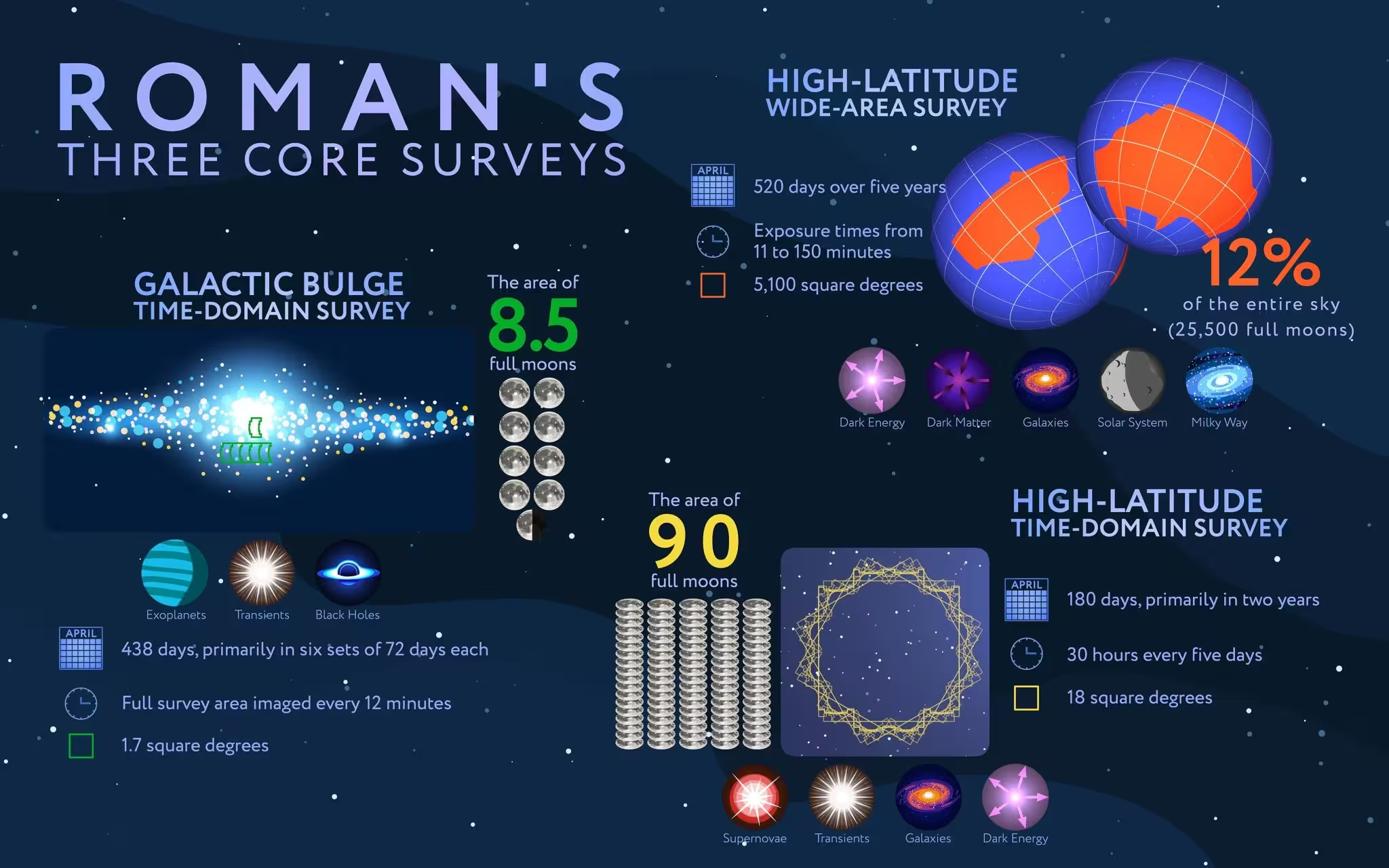
NASA’s Nancy Grace Roman Space Telescope’s three main observing programs, highlighted in this infographic, can enable astronomers to view the universe as never before, revealing billions of cosmic objects strewn across enormous swaths of space-time.
Why does that matter? Nearly all known exoplanets have been found by indirect shadow plays—tiny dips in starlight or wobbles in motion. Coronagraphy tries to show the planet itself: its reflected light, its atmosphere, perhaps signs of clouds or chemistry. For mission designers and future telescopes aimed at habitability, Roman’s coronagraph is a pathfinder.
University of Arizona scientists are already preparing for those observations. Teams led by Mark Marley, Ewan S. Douglas, Ramya Anche, and Justin Hom helped develop the coronagraph and will use it to probe planetary atmospheres, system architecture, and to select stars for calibration. Zarah Brown has been modeling the infrared spectra of young, self-luminous giant planets—worlds that glow in the thermal infrared because they are still hot from formation. Those models are the scouting reports mission planners need to choose exposure times without wasting precious observing hours.
Roman’s schedule moves fast: its science operations are slated to begin in January 2027, and the mission will make data broadly available to the community. The University of Arizona will lead nine approved investigations using Roman data, spanning dark energy and exoplanets but extending into studies of supermassive black holes, gravitational lenses, galaxy formation, and cosmic dust.
There is a real sense of choreography here—teams around the world, instruments designed to complement one another, and the computational horsepower to interpret what will be a flood of photons. Roman isn’t designed to replace Hubble or Webb. It’s designed to change the questions we ask of them, to find what they might miss, and to give astronomers the wide context needed to understand where a single discovery sits in the cosmos.

One practical thought lingers: when the sky can be mapped with both breadth and Hubble-like clarity, what previously invisible patterns will suddenly snap into focus?

Leave a Comment
Comments (2)
If coronagraphy actually reveals planets 100Mx fainter, that's insane. Skeptical about real noise floors tho, calibration will be brutal. Still, curious to see first pics.
Whoa, Roman sounds like a dream. Hubble-like detail for vast sky patches? Mind blown, but the data flood makes me nervous, can our pipelines really keep up? excited tho