
2 Minutes
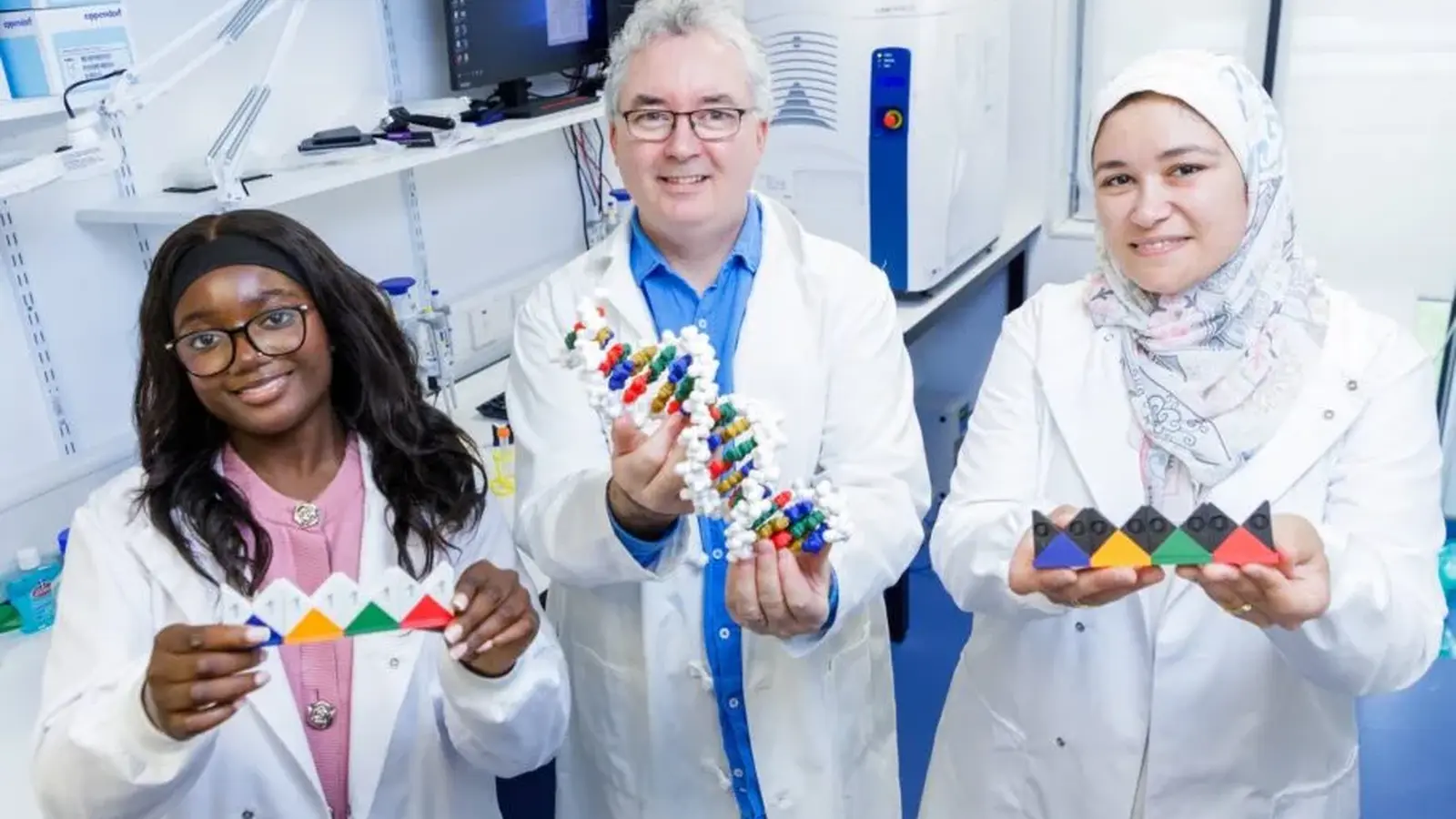
Picture a tiny machine the size of a speck that can calculate without a plug or battery. Sounds like science fiction? Researchers at Maynooth University in Ireland have built precisely that: a molecular computer made from strands of DNA that performs math through chemistry, not electricity.
The trick is DNA origami. Scientists program a long scaffold strand and dozens—hundreds—of short, custom ’staple’ strands using design software. Drop them into a salty drop of water, cycle the temperature, and the strands fold and snap together into a precise microscopic framework. The long strand acts like scaffolding; the short strands lock the shape in place. The result is a physical network capable of carrying out computation.
What makes this more than a clever assembly is how the logic runs. Instead of transistors switching with electrons, chemical reactions shuttle information between molecular components. The Maynooth team ran ten different molecular programs on their system. It handled basic arithmetic—addition, subtraction, multiplication, division—and, remarkably, processed 100-bit calculations. No electricity required. Processing happens as reactions proceed and structures reconfigure.

Why does this matter? For one, energy. These systems compute with almost no power, which makes them attractive for ultra-low-energy tasks and environments where conventional power is scarce. For another, scale and permanence: DNA is dense and durable, which has long made it a candidate for long-term data storage. And there’s a more intimate possibility—embedding molecular computing inside living cells for sensing or diagnostics, where electronic hardware simply can't go.
The work, reported in Nature and summarized for readers by outlets including Tom’s Hardware, is an early but persuasive step toward practical molecular devices. There are engineering hurdles ahead—speed, error rates, and interfacing with conventional electronics among them—but the experiment shifts the conversation. Could future sensors, archival media, or even tiny therapeutic machines run on chemistry rather than copper? We may be closer than we think.

Leave a Comment
Comments
No comments yet. Be the first.