

4 Minutes
Introduction
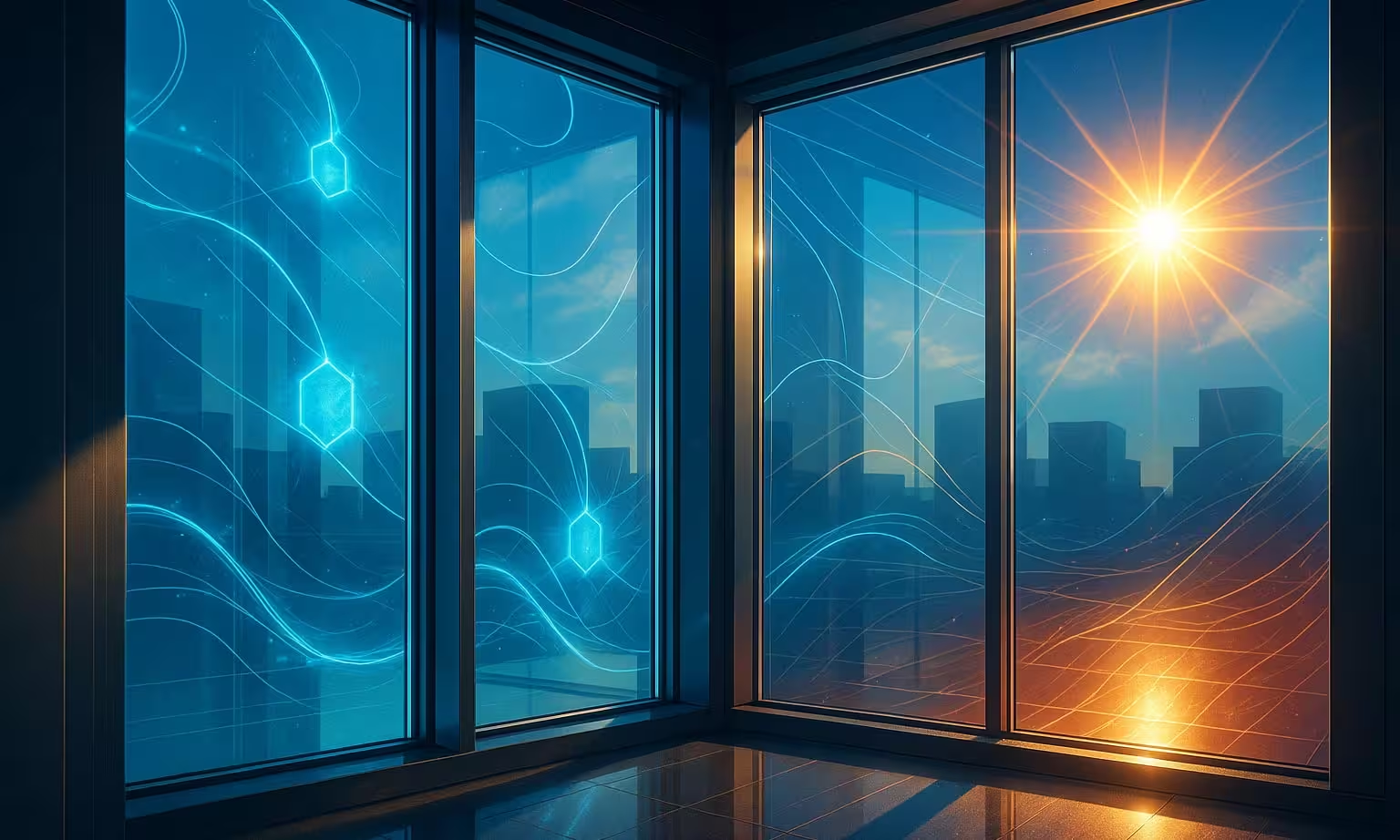
Scientists at Nanjing University have developed a transparent coating that can convert ordinary window glass into an active solar energy surface while remaining largely see-through. The technology, called a colorless and unidirectional diffractive-type solar concentrator (CUSC), channels a portion of incoming sunlight sideways within the glass toward photovoltaic (PV) cells mounted at the window edges. Other wavelengths continue to transmit through the pane, preserving natural daylight and visual clarity.
This approach targets building-integrated photovoltaics (BIPV), a sector focused on embedding energy generation into existing structures. If scaled to cover the global stock of windows, the researchers estimate a potential contribution to electricity supply measured in terawatts, making the idea geopolitically and economically significant for decarbonization strategies.
How the coating works
The CUSC coating uses stacked layers of cholesteric liquid crystals (CLCs). CLCs are a class of liquid-crystal materials with a helical molecular arrangement that selectively interacts with circularly polarized light. By engineering multiple CLC layers with different optical responses, the coating can span a broad portion of the visible spectrum while remaining colorless to human observers.
A key design feature is polarization selectivity: the films diffract and trap only one circular polarization state of light. That single polarization is guided into the glass at steep angles, traveling by internal reflection until it reaches PV strips at the window perimeter. Untrapped light—including the orthogonal polarization—passes through the glass with limited attenuation. According to the team, the coating transmits 64.2% of visible light and preserves 91.3% of perceived color accuracy, maintaining the aesthetic and functional qualities expected of windows.
Optical engineer Wei Hu summarizes the objective: "The CUSC design is a step forward in integrating solar technology into the built environment without sacrificing aesthetics. It represents a practical and scalable strategy for carbon reduction and energy self-sufficiency." Colleague Dewei Zhang adds: "By engineering the structure of cholesteric liquid crystal films, we create a system that selectively diffracts circularly polarized light, guiding it into the glass waveguide at steep angles."

Prototype results and scalability
Laboratory tests provide a mixed but promising performance picture. Under green laser illumination—near the wavelength where human eyes are most sensitive—the system captured and converted up to 38.1% of incident energy, a useful upper bound for certain monochromatic applications. Under broad-spectrum, more realistic solar illumination, the stacked-CLC concentrator delivered an overall optical collection efficiency of 18.1% in guiding light to the edge-mounted PV cells. However, when accounting for end-to-end power conversion into usable electricity in the current prototype, the effective power conversion efficiency is about 3.7%.
The team fabricated a one-inch demonstration sample that generated enough electricity to run a small fan. Scaling that design to full-size commercial windows would require larger-area coating processes, reliable lamination or deposition onto existing glass, and integrated edge PV modules. The researchers note that improvements in material stability, manufacturing throughput, and cell coupling are required to raise practical conversion efficiency and to support mass production.
Related technologies include transparent conductive oxides, luminescent solar concentrators, and perovskite-on-glass integrations; each approach balances trade-offs in transparency, cost, and durability. The CUSC method is distinct in using diffractive guidance and polarization control rather than absorption-emission cycles or bulk transparency compromises.
.avif)
Expert Insight
Dr. Maria Alvarez, an applied physicist specializing in building photovoltaics, comments: "This diffractive, polarization-selective strategy is elegant because it minimizes visible intrusion while enabling edge collection. The current 3.7% system-level efficiency is modest, but the pathway to improvement is clear: optimize the liquid-crystal stack, increase edge-cell conversion, and develop roll-to-roll coatings. If those engineering steps succeed, the technology could be an important complement to rooftop and facade PV."
Conclusion
The CUSC transparent coating developed by Nanjing University researchers demonstrates a practical route to convert ordinary windows into energy-producing elements with minimal visual impact. Core strengths include high visible transparency, color fidelity, and a polarization-selective diffractive mechanism that routes light efficiently to edge-mounted photovoltaic cells. Prototype metrics show promising optical guidance performance (up to 18.1% across the spectrum; 38.1% under green laser testing) but a current end-use electrical efficiency of about 3.7%. Key next steps are improving material stability, manufacturing processes, and power conversion efficiency to reach commercial viability. If successfully scaled, transparent window coatings like CUSC could expand the surface area available for solar harvesting in urban environments and contribute meaningfully to distributed clean energy generation.











Leave a Comment
Comments
No comments yet. Be the first.