
4 Minutes
Some people seem to never forget a face. Recent research from the University of New South Wales helps explain why: top face recognizers don’t try harder, they look smarter — selectively tuning in to the most diagnostic features on a person’s face.
How elite face memory differs from ordinary recognition
Imagine meeting someone once and recalling their face months later with uncanny precision. Psychologists call these people super-recognizers. A new study led by James Dunn at UNSW Sydney used eye-tracking and machine learning to compare how 37 super-recognizers and 68 typical observers scan new faces.
Instead of staring broadly at the center of the face, super-recognizers rapidly break faces into meaningful parts — an approach researchers liken to turning a face into a visual jigsaw. They spend less time on redundant areas and more on features that uniquely identify a person, such as an unusual eyebrow shape, a distinctive cheek contour, or a specific spacing between features.
What the experiment measured and why it matters
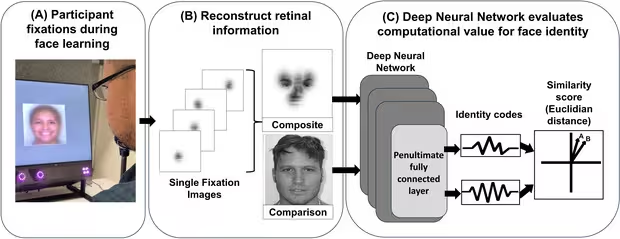
Participants viewed images on a screen while an eye-tracker recorded where and for how long they looked. The team reconstructed the visual information captured by those eye movements and fed it into deep neural networks trained to match faces. The goal: test which human gaze patterns contained the most useful data for identifying identity.
When the algorithms received eye-data from super-recognizers, they were better at deciding whether two photos showed the same person than when given data from typical observers. "Their skill isn't something you can learn like a trick," Dunn told the researchers. “It's an automatic, dynamic way of picking up what makes each face unique.”
Perception starts at the eye — and maybe at the retina
One of the study’s striking implications is that the roots of exceptional face recognition may begin earlier than we thought: at the retinal encoding stage of vision. In other words, differences in how visual information is first sampled and encoded could set the stage for later facial identity processing. The authors suggest that super-recognizers don’t just process more facial data; they prioritize the most diagnostic pieces of information from the outset.

Caricature as an analogy
Dunn uses caricature as an analogy: exaggerating distinctive features makes a face easier to recognize. Super-recognizers seem to accomplish a similar effect naturally — their gaze exaggerates the visual weight of telling features, making identification more reliable.
Implications for AI, security and social cognition
This research offers a two-way street between neuroscience and technology. On one hand, deep neural networks helped reveal which human eye patterns are most informative; on the other, insights from elite human perceivers could refine machine face-recognition systems. Current AI excels at many controlled face-matching tasks, but humans still draw on contextual cues in social situations, giving us an edge in ambiguous real-world encounters.
There are ethical and practical dimensions to consider. Better algorithms informed by human strategies could improve security screening or forensic work, but they also raise concerns about surveillance and privacy. The authors note a robust genetic component to superior face memory, and they remind us that face-identity processing is deeply embedded in primate social behavior — so this ability likely has deep evolutionary roots rather than being a purely modern human quirk.
Future directions: training, tools and limits
Is it possible to teach ordinary people to see like super-recognizers? The study is cautious: the patterns observed appear automatic and dynamic, not a simple skill you can learn through a single training trick. Still, understanding what features matter most could inform perceptual training programs, improved eyewitness procedures, or user interfaces that highlight diagnostic facial information for identification tasks.
Expert Insight
"This work elegantly ties behavioral eye-tracking to computational models, revealing that the 'where' of gaze matters as much as the 'how long,'" says Dr. Maria Alvarez, a cognitive neuroscientist specializing in visual perception. "Integrating human gaze patterns with machine learning could speed up AI development while also showing us where human and machine strategies diverge in real-world identification."

By combining eye-tracking, neural networks and careful behavioral testing, the study offers a clearer portrait of why some people never forget a face — and how those insights could ripple into technology, forensics, and our understanding of social vision.

Leave a Comment
Comments (2)
is this even true? genetics + retina deciding who remembers faces? feels like a big claim. can normal people learn the gaze tricks, or nah
wow didn't expect retinal sampling to matter so early. sounds plausible, they just zero in on odd brows, spacing. if only we could train that, huh