
4 Minutes
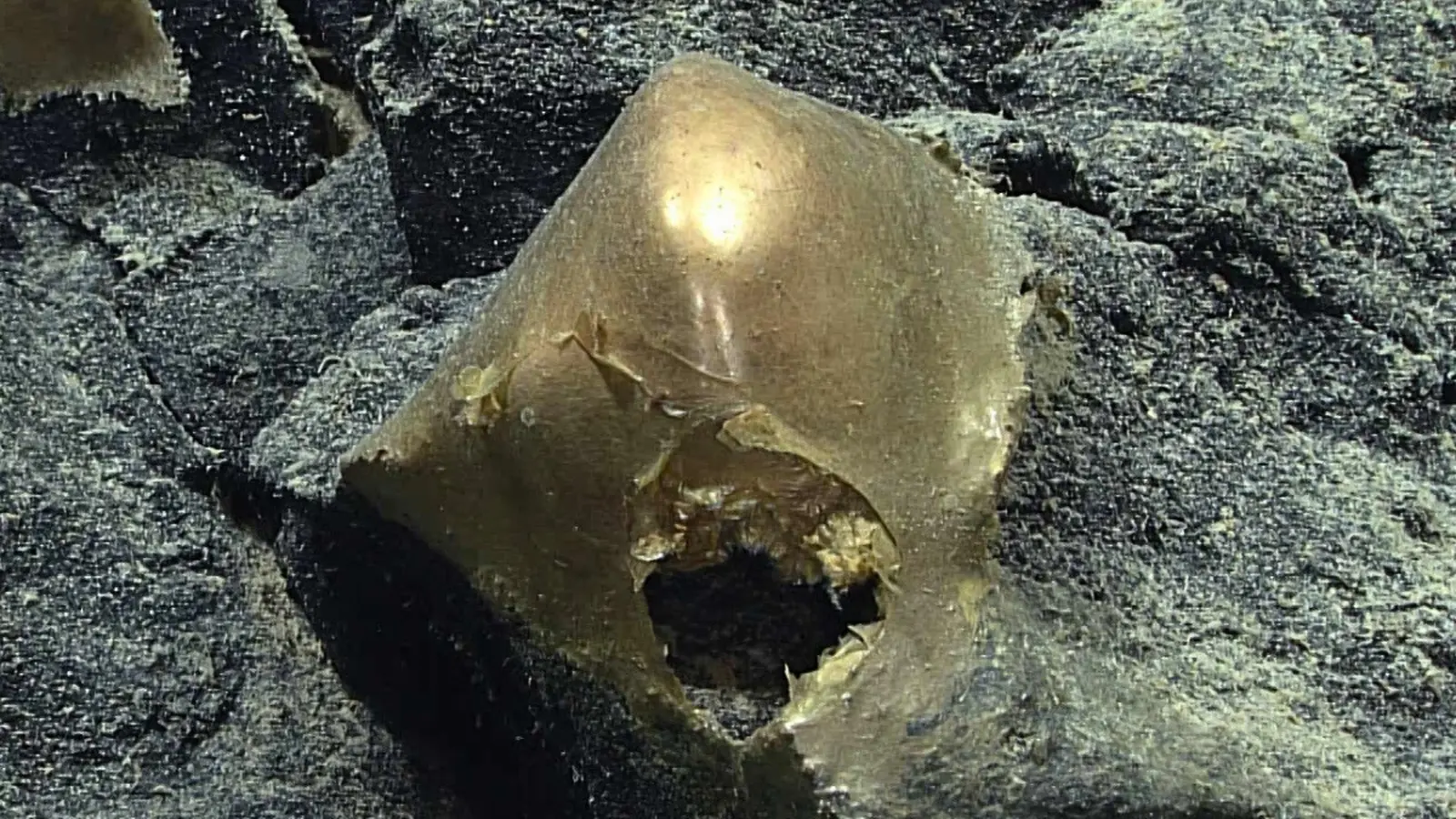
During a 23‑day NOAA Ocean Exploration mission off Alaska, a remotely operated vehicle (ROV) encountered an object that has left scientists puzzled: a soft, golden orb clinging to a rock more than 3,300 meters below the surface. The discovery — roughly 10 centimeters across and pierced by a single hole — raises questions about deep‑sea life, reproductive strategies, and how much of the ocean still remains unknown.
A strange find in the abyss
The object was spotted during a 2023 dive in terrain where sunlight never reaches and pressures are immense. Using the ROV, researchers observed a round, fleshy structure attached tightly to a rock encrusted with white sponges. The orb measured about 10 centimeters (4 inches) in diameter and featured a conspicuous hole on one side — a detail that immediately prompted speculation.
Live commentary from the dive captured the team's genuine uncertainty. One participant said, "I don't know what to make of that," while another noted, "It's definitely got a big old hole in it, so something either tried to get in or tried to get out." A third joked nervously, "I just hope when we poke it, something doesn't decide to come out," likening the scene to the opening of a horror movie.
Using a robotic arm and a gentle suction sampler, the team nudged the object and confirmed it was soft to the touch before bringing it aboard the NOAA vessel Okeanos Explorer for closer analysis.
.avif)
The mystery blob was carefully collected using a suction sampler
What could it be? Egg, sponge, coral — or something else?
Researchers initially proposed several hypotheses: a dead sponge, a coral, or perhaps an egg casing. Deep‑sea ecologist Kerry Howell of the University of Plymouth told The Guardian the texture felt "fleshy" and lacked obvious anatomy — traits that led the team to favor the egg hypothesis. "If it is an egg, the really interesting question is whose egg it is," Howell said. At roughly 10 centimeters across, this object is far larger than typical fish eggs, suggesting a large parent or an unusual reproductive strategy.
Oviparous animals usually deposit eggs in clutches or nests, making the isolated placement of this orb especially intriguing. A solitary egg case of this size would be atypical and could reveal previously undocumented life history strategies in the deep sea.
.avif)
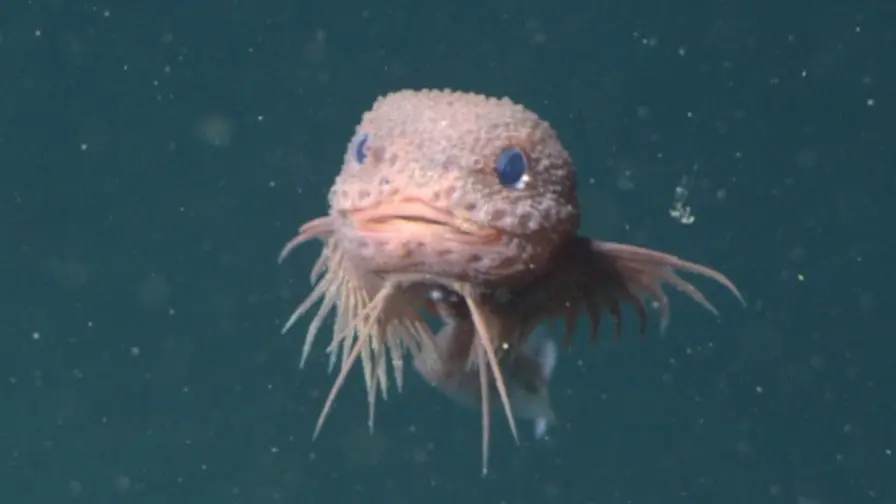
The mystery blob photographed onboard the NOAA vessel Okeanos Explorer after collection
Scientific context: why this matters
Exploring the deep ocean is challenging. Extreme cold, crushing pressure, and vast darkness have limited human observation, and a 2025 analysis of publicly available deep‑sea dive footage found we have visually explored only about 0.001 percent of the deep seafloor. That tiny fraction suggests countless biological discoveries remain possible, from novel species to unexpected behaviors and reproductive modes.
Finding an unidentifiable biological object highlights the limits of current knowledge and the importance of ROVs as tools for expanding it. By bringing the specimen aboard, scientists can apply microscopy, genetic sequencing, and chemical analysis to determine its composition and origin. DNA barcoding, for instance, could reveal whether tissue inside the orb matches known taxa or points to a new lineage.
Implications and next steps
If genetic tests confirm that the orb is an egg, researchers will look for parental traces, developmental stages, or related structures in the region. If it proves to be a sponge, coral, or another sessile organism, its unusual morphology will still shed light on how life adapts to the abyssal environment. Either way, the specimen is a reminder that even well‑funded expeditions can produce genuine surprises.
As Sam Candio, exploration coordinator at NOAA Ocean Exploration, put it: "Isn't the deep sea so delightfully strange? While we were able to collect the 'golden orb' and bring it onto the ship, we still are not able to identify it beyond the fact that it is biological in origin. While somewhat humbling to be stumped by this finding, it serves as a reminder of how little we know about our own planet and how much is left to learn and appreciate about our ocean."
Expert Insight
"Objects like this are valuable because they force us to refine our hypotheses about deep‑sea life," says Dr. Elena Marcos, a fictional but realistic deep‑sea biologist and science communicator. "Even if the final identification is mundane, the process — from ROV observation to molecular analysis — expands our toolkit and often leads to unexpected side discoveries about ecology, chemistry, or biomechanics in the deep sea."

In the coming months, lab tests on the orb will determine its cellular structure, genetic signature, and possible developmental stage. Whether it turns out to be an egg of a large, unknown animal or an unusual sponge/coral variant, the find underscores the ongoing value of deep‑ocean exploration for revealing Earth's hidden biodiversity.

Leave a Comment
Comments (2)
is this even real or just an ROV artifact? looks fleshy but could be detritus or sponge tissue, kinda skeptical rn
Wow that orb is wild! Like something from a sci-fi horror. Egg of a giant squid? please tell me they DNA-seq it soon...