
6 Minutes
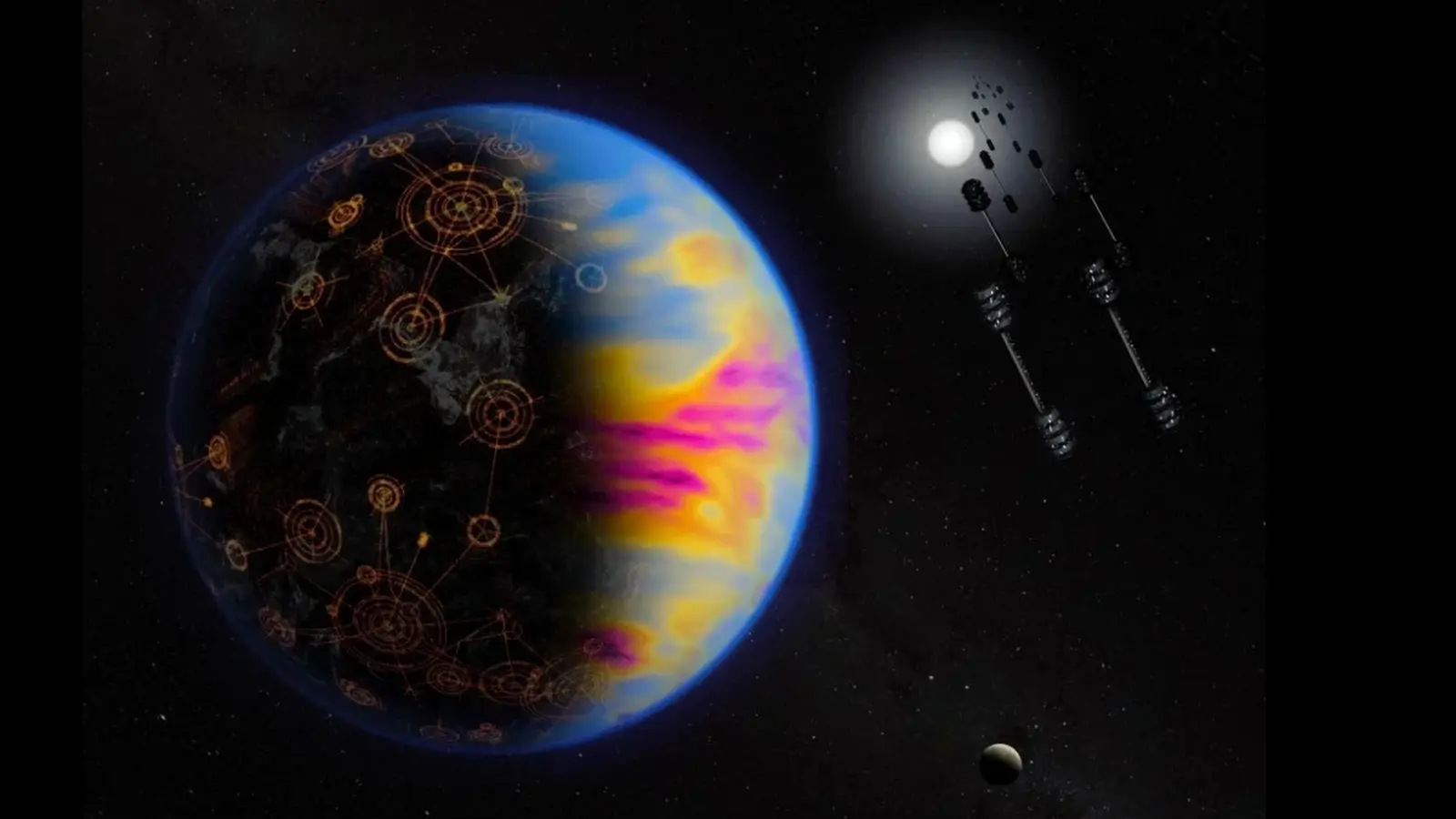
Imagine humanity's first undeniable sign of an alien civilization arriving not as a diplomat, ship, or message, but as a glaringly obvious, transient burst in our astronomical data. That is the provocative idea behind the Eschatian Hypothesis: the first confirmed detection of extraterrestrial technology could be an unusually strong, short-lived technosignature — a cosmic scream rather than a whisper.
Why the loud signal idea is plausible
Our history of discovery in astronomy is shaped by detection biases. The first members of a new class of objects we identify are often the brightest, the biggest, or otherwise the most conspicuous. That pattern repeats from the earliest exoplanets to the stars we notice without a telescope.
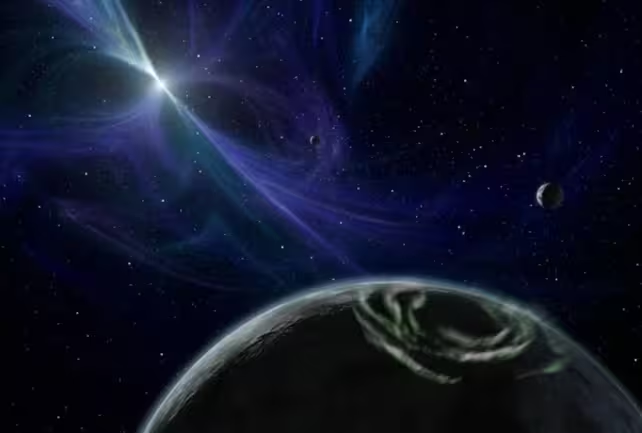
Take exoplanets: the first planets discovered outside our solar system orbited pulsars in the 1990s. Pulsars act like highly precise cosmic clocks, so even a small planet can alter timing in a way that's easy to spot. But pulsar planets are rare within the larger population of exoplanets. They were detected first because their observational signature was unusually large, not because they represented the typical case.
Similarly, many stars visible to the naked eye are evolved giants — a disproportionate share compared with the actual stellar census — simply because their luminosity makes them jump out at human eyes. A dim red dwarf, although common, remains effectively invisible to unaided observers.
David Kipping, director of Columbia University's Cool Worlds Lab, has extended this logic to extraterrestrial intelligence (ETI). In his new paper, he proposes that first contact is likely to be a loud outlier — a civ producing a strong technosignature that stands above the ordinary background of astrophysical phenomena. He dubs this the 'Eschatian Hypothesis' — from eschatology, the study of end-times — suggesting these loud signals may be linked to transitory, unstable, or even terminal phases in a civilization's history.
Examples from astronomical history that echo the hypothesis
Supernovae provide a vivid analogue. They are spectacular because they mark dramatic endings: the death throes of stars. Their luminosity is extreme and transient, making them among the first and easiest cosmic events to detect on large scales. If a technological civilization emits a comparably extreme but short-lived signature — perhaps as a by-product of collapse, collapse mitigation, or deliberate broadcast — it could likewise be the first sign we spot.
Consider another famous anomaly: the Wow! signal of 1977. A narrow-band radio burst detected by the Big Ear radio telescope, the Wow! signal has never been explained convincingly. Kipping has asked whether that pattern could be the equivalent of a loud cry for help — a civilization facing an existential downturn and broadcasting strongly as a final act. While speculative, this framing helps shift search strategies from narrowly defined beacons to broader searches for anomalies and outliers.
How detection bias shapes our expectations
The central practical message is straightforward: our search tools favor extremes. Surveys and instruments are tuned to pick up large signals, fast transients, or very bright objects. That means if an ETI leaves a subtle, steady technosignature, it may remain buried in data — but a dramatic, anomalous event will stand out.
Modern observatories are moving into an era of continuous, large-scale time-domain monitoring. Facilities such as the Vera Rubin Observatory and legacy projects like the Sloan Digital Sky Survey scan the sky repeatedly to capture changes in flux, spectrum, and motion. These wide-field, high-cadence surveys are precisely the kind of systems Kipping identifies as our best bet to catch ‘loud,’ short-lived technosignatures.
Search strategies: look for anomalies, not just beacons
Adopting the Eschatian perspective changes tactical choices. Instead of hunting for narrowly defined radio beacons or optical lasers targeted at Earth, researchers would prioritize agnostic anomaly detection: identifying transients and spectral oddities that defy astrophysical explanation. That could include unusual chemical signatures in exoplanet atmospheres, abrupt, high-energy flares with atypical spectra, or systematic pollution signals inconsistent with known stellar or planetary processes.
For instance, a sudden spike in industrial gases around an exoplanet — far above natural background expectations — might be interpreted as a technosignature. Likewise, unexplained transient emissions in narrow frequency bands or rapidly evolving broadband outbursts could merit deeper follow-up rather than dismissal as instrumentation noise.
Implications for SETI and future observatories
Embracing loud, atypical first-contact scenarios broadens the scope of SETI (Search for Extraterrestrial Intelligence). It encourages cross-disciplinary approaches, combining radio, optical, infrared, and time-domain astronomy with machine learning methods for anomaly detection. Instruments that repeatedly survey large areas of sky are especially valuable, because they increase the chance of catching short-lived events.
This focus also raises philosophical questions about what an extraterrestrial civilization's 'end' might look like and whether signatures of collapse or crisis are more detectable than long-lived, sustainable civilizations that deliberately minimize their detectable footprint.
Expert Insight
Dr. Lia Moreno, an astrophysicist specializing in time-domain surveys, comments: 'The Eschatian Hypothesis is a useful corrective. It reminds us that detection is often about contrast: how conspicuous something is against a noisy sky. Instruments like the Rubin Observatory will flood us with transient events. The challenge — and opportunity — is to develop robust, rapid triage systems that can flag genuinely anomalous signals for immediate follow-up. If a civilization is shouting, we want to be listening with the right instruments.'
What this means for the public imagination
Popular culture tends to imagine first contact as cinematic: grand ships, diplomatic dialogues, or hostile invasions. The Eschatian view replaces spectacle with subtlety and urgency. It asks us to consider quieter, more sobering possibilities — that a detectable civilization might be in trouble, or that detection itself will be an unexpected, anomalous blip that requires careful analysis rather than instant interpretation.
That shift has ethical dimensions too. If a loud signal is indeed a distress call, how should humanity respond? If it is the signature of collapse, does detection carry responsibilities beyond scientific curiosity? While answers remain speculative, the hypothesis encourages the scientific community and the public to consider a wider range of possibilities — and to build observational systems that are sensitive to the unexpected.
Looking ahead: technologies and prospects

To maximize the chance of registering loud technosignatures, astronomers will combine broad-time surveys with targeted follow-up using radio arrays, infrared telescopes, and spectrometers capable of detecting unusual atmospheric chemistry. Machine learning will play a key role in sorting through petabytes of data to find small sets of truly anomalous candidates.
Whether or not the Eschatian Hypothesis proves correct, it reframes our search for extraterrestrial intelligence. Instead of assuming the first signal will be polite, sustained, and representative, we should be prepared for loud, atypical, and possibly ephemeral phenomena. And in that readiness lies the best chance of recognizing a genuine, earth-shaking discovery when it finally appears in our data.









Leave a Comment
Comments (2)
Sounds plausible but kinda fatalistic. If they're shouting in a last gasp why would we be in earshot? Could be RFI or a glitch. Skeptical, curious.
Whoa, cosmic scream as first contact? unsettling and kinda brilliant... imagine catching one burst and never knowing who it was. we need fast triage, pronto