
5 Minutes
One algorithm has turned decades of Hubble observations into a treasure map of the unexpected. In just a few days, a machine-learning tool sifted through nearly 100 million image cutouts and pulled out more than a thousand objects that look, at first glance, like curiosities — and, on closer inspection, like opportunities.
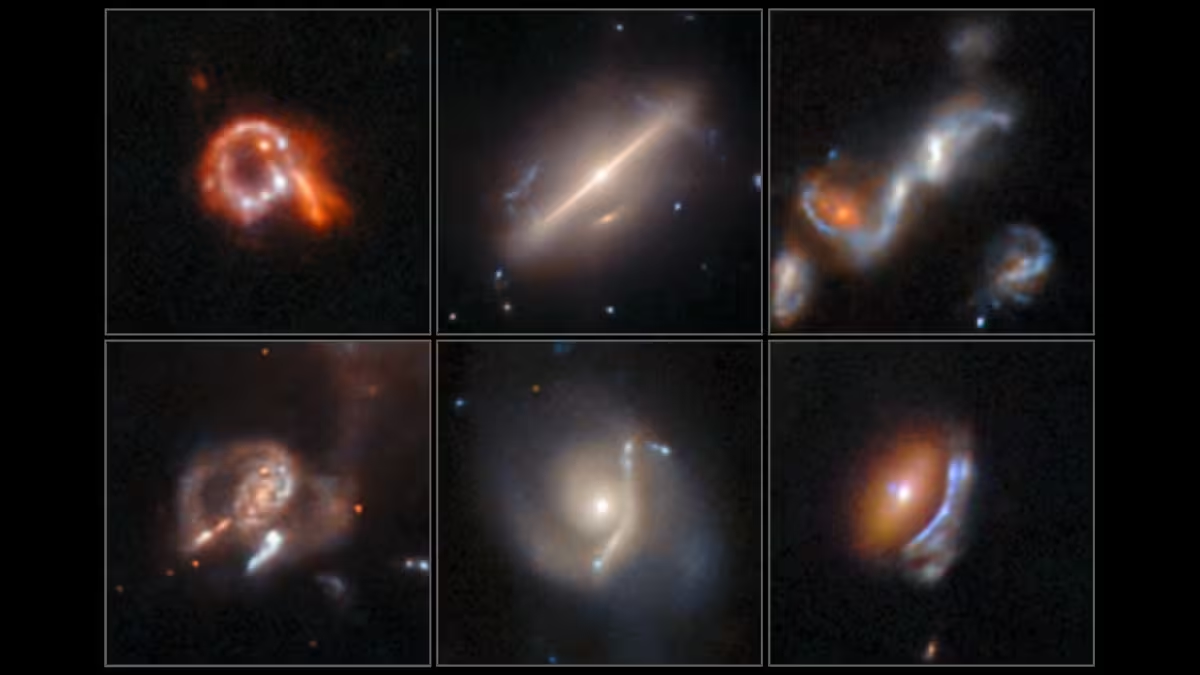
Six previously undiscovered, weird and fascinating astrophysical objects are displayed in this new image from NASA's Hubble Space Telescope. (NASA, ESA, David O'Ryan (ESA), Pablo Gómez (ESA), Mahdi Zamani (ESA/Hubble))
How the search worked
Hubble's image archive stretches back roughly 35 years. It is enormous. It is messy. It is stubbornly human-sized in a way that now slows discovery. Instruments such as the James Webb Space Telescope and the forthcoming Vera Rubin Observatory generate torrents of data — terabytes per night in some cases — and the Hubble Legacy Archive sits underneath that rising tide as a reservoir of underexplored information.
Enter AnomalyMatch: a semi-supervised anomaly-detection framework built around modern neural networks. Unlike traditional classifiers trained to look for a fixed set of known objects, AnomalyMatch flags examples that deviate from the expected patterns learned from the archive itself. The team led by David O'Ryan and Pablo Gómez at ESA fed the system roughly 100 million Hubble cutouts. The result: a ranked shortlist of candidate anomalies that humans can realistically inspect.
Speed is part of the point. The developers report that AnomalyMatch processed the dataset in roughly two to three days on a single GPU — a task that would take many human teams far longer. But speed without curation is noise; the neural net provided a manageable list of about 1,400 candidates that scientists could verify by eye.
Discoveries and scientific value
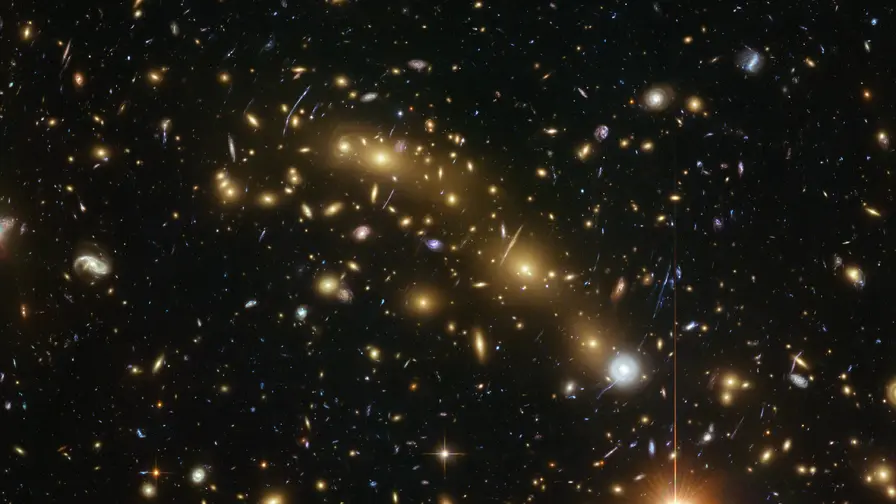
From the shortlist, O'Ryan and Gómez confirmed about 1,300 genuine anomalies. More than 800 of those appear to be previously undocumented. What did the AI surface? A wide variety: interacting and merging galaxies dominate the sample, with 417 such systems noted. The archive also yielded 86 new gravitational-lens candidates — systems where a massive foreground object bends the light of a background source. These lenses are not just curiosities; they act as natural telescopes, magnifying faint or distant galaxies and allowing astrophysicists to probe the distribution of dark matter, refine distance measures, and test general relativity on cosmic scales.
AnomalyMatch also identified rarities such as jellyfish galaxies — cluster galaxies losing gas as they plow through a dense medium, trailing star-forming filaments — and several ring and collisional-ring galaxies. It even pulled up objects at the threshold of Hubble's sensitivity: high-redshift systems whose faint signatures require careful scrutiny. Jetted active galactic nuclei and unusual AGN-host configurations were among other finds, along with overlapping, clumpy, and otherwise morphologically strange galaxies.

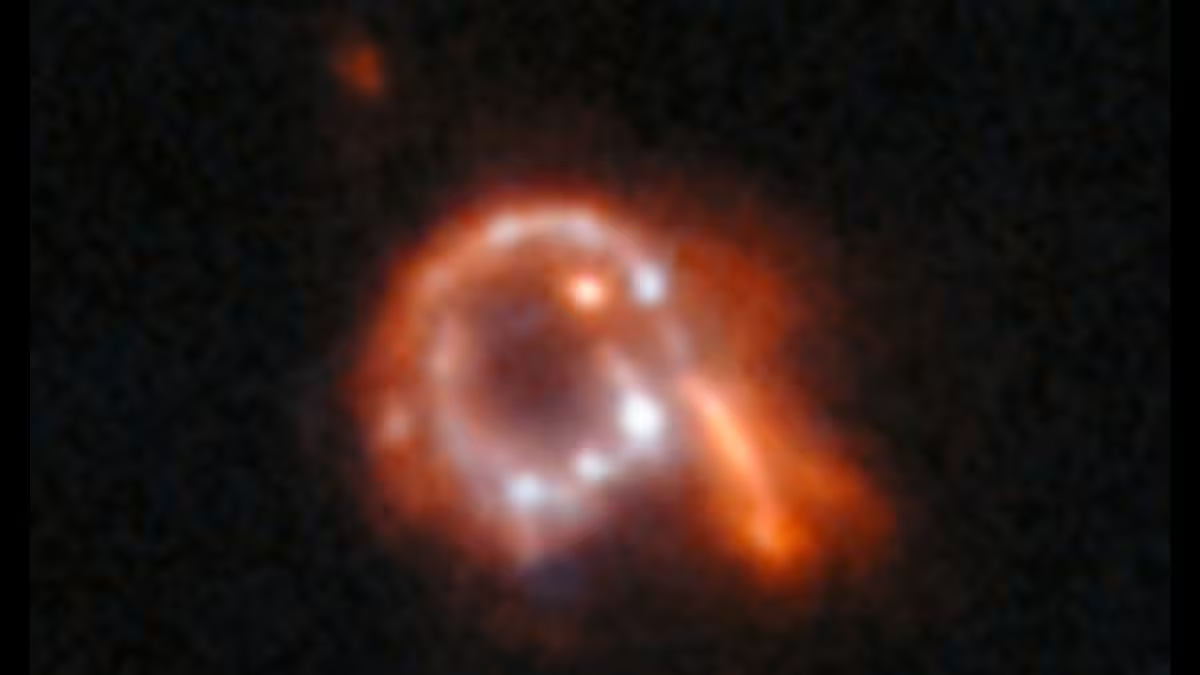
An anomaly from Hubble's archive, classified as a "collisional ring" galaxy – one of only two that were found. (ESA/Hubble & NASA, D. O'Ryan, P. Gómez (European Space Agency), M. Zamani (ESA/Hubble))
Why hunt anomalies? Because outliers often teach us the most. They reveal physical regimes or evolutionary pathways that standard surveys and selection algorithms miss. A rare interaction, an oddly stripped galaxy, a lens with an unusual mass distribution — these objects can drive follow-up observations that lead to new astrophysical insights.
Context: archives, telescopes and the data deluge
Hubble's archive is only one layer of a much larger data landscape. The James Webb Space Telescope produces tens of gigabytes per day depending on its program. The Vera Rubin Observatory will push data scales even further, producing roughly 20 terabytes of raw data nightly when it comes online. Giant Magellan and Extremely Large Telescopes will add depth and resolution, but they will not slow the flow. Humans cannot eyeball all of this information. Machines can prioritize. Machines can find the strange things worth human attention.
That partnership — algorithmic triage followed by human interpretation — is emerging as a pragmatic workflow. AI does the broad net; scientists do the fine sorting, physical modeling, and contextual reasoning. The Hubble study is a concrete example: an archive re-examined with new tools yielded hundreds of scientifically interesting objects that had previously gone unnoticed.
Expert Insight
"This work shows how algorithmic search can dramatically increase the scientific return of archival data," says Dr. Leila Banerjee, an observational cosmologist at the University of Cambridge. "Anomaly detection doesn't replace hypothesis-driven science; it supplements it by pointing to regions of parameter space we might otherwise never examine. The most exciting part is that many of these candidates will be prime targets for spectroscopy and higher-resolution follow-up — the kinds of observations that turn anomalies into physics."
The research team notes that the method is scalable. The architecture behind AnomalyMatch is designed for large-scale deployment, which means similar searches can be run on other archives such as ESA's Gaia or combined Hubble-plus-JWST datasets. As models improve and as multi-wavelength archives interlink, the potential for discovering truly novel phenomena grows.
For now, the catalog of newly flagged Hubble anomalies offers a rich starting point: candidates for gravitational-lens confirmation, puzzling morphologies begging for dynamical modeling, and borderline detections that may become clear with targeted observations. The archive, it turns out, still has surprises — if you know where to look and let the right tools point the way.

Who will follow up next? The answer will shape which of these oddities become breakthroughs rather than footnotes.







Leave a Comment
Comments (2)
not convinced yet, anomaly detection is cool but false positives are real. 1,400 trimmed to 1,300? how many junk hits, what's the purity metric, show ROC pls...
wow Hubble still surprises me. AI did the grunt work, humans get the mysteries. 800+ new oddballs? yes please. followup spectra asap, fingers crossed