
5 Minutes
A simple prescription — about 150 minutes of brisk activity each week — may do more for the brain than most of us expect. That's the headline from a year-long clinical trial that used MRI biomarkers to probe whether regular exercise alters the brain's biological age. The findings are modest in scale but striking in implication: supervised, guideline-based aerobic activity nudged the brain toward a younger biological profile than in people who kept their usual routines.
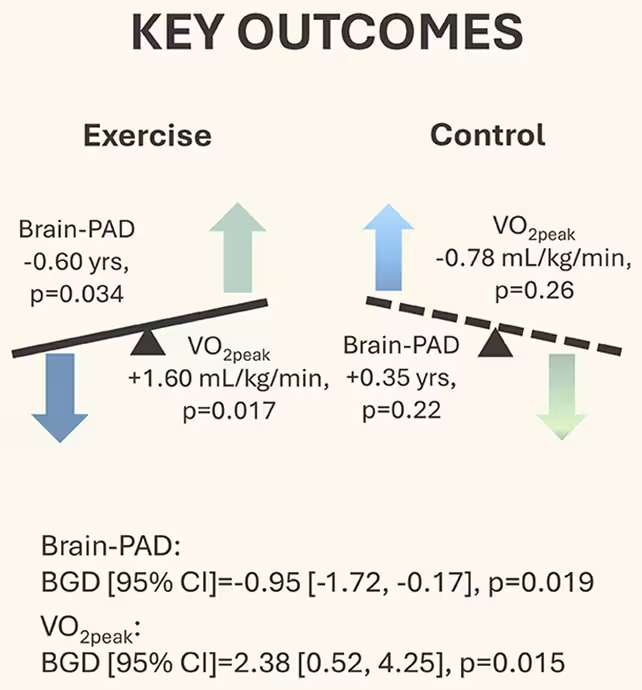
The trial enrolled 130 healthy adults aged 26 to 58 and followed them for 12 months. One group was coached to meet the World Health Organization's weekly goal of roughly 150 minutes of moderate-to-vigorous exercise — think sustained brisk walking, cycling, or other activities that raise heart rate and breathing. A control group carried on as before. At the end of the year, researchers ran MRI-based assessments and calculated a range of brain-aging biomarkers. On average, the exercisers' brains appeared about 0.6 years younger than their chronological age, while the non-exercise group had brains that loosely tracked slightly older than their calendar years. The net difference between groups approached roughly one year of brain age.
The study, led by data scientist Lu Wan at the AdventHealth Research Institute and published in the Journal of Sport and Health Science in 2026, does not claim dramatic reversal of aging. Small shifts can matter, though, particularly when multiplied over decades. A one-year delay in brain aging across a population could translate into later onset of cognitive decline and fewer years lived with impairment. Who wouldn't like a buffer like that?
How the trial measured 'brain age'
'Biological age' is a shorthand for accumulated wear and tear that varies across tissues. In the brain, MRI offers multiple windows into structure and function — volumes of specific regions, white-matter integrity, patterns of connectivity, and other measurable signals. The trial combined several of those MRI-derived markers to estimate each participant's brain age relative to their chronological age. These composite measures are not a crystal ball, but they capture features that typically shift with aging and with diseases such as dementia.
Interestingly, the investigators did not find a clear single mediator for the exercise effect. Improvements in cardiovascular fitness, blood pressure, and concentrations of certain proteins were evaluated, but none fully explained the younger brain signals. 'We expected fitness or blood pressure to account for the effect, but they didn't,' the team reports — suggesting that exercise may act through subtler, overlapping mechanisms that the study's battery did not capture, such as low-grade inflammation, microvascular changes, or microscopic structural remodeling of neural tissue.
Methodologically, the trial was well controlled for a behavior study: it had a defined intervention, a reasonable sample size for an imaging project, and objective MRI outcomes. Yet the cohort was still limited to healthy adults in midlife and did not assess cognitive outcomes across many years. The next step is clear: larger, more diverse cohorts and longer follow-up to see whether the MRI signal translates into preserved memory, executive function, and reduced dementia incidence.

Why midlife matters
Mounting evidence suggests that processes leading to late-life cognitive impairment often begin decades earlier. Midlife is therefore a strategic window for interventions. Exercise has already been tied to better sleep, improved metabolic health, and longer life expectancy. Adding a demonstrable shift in brain aging to that list reinforces the idea that lifestyle choices in our 30s, 40s, and 50s have downstream consequences for neurological health.
There are practical implications. The activity level used in the study aligns with existing public-health guidance, which means the prescription is achievable for many people: about 150 minutes of moderate-to-vigorous aerobic exercise per week, paired with the usual recommendations on strength training. It does not require extreme regimens or expensive equipment — just consistency.
Expert Insight
'This study refines what we've long suspected: that routine aerobic activity preserves brain health in ways we can now see with imaging,' says Dr. Maya Singh, a cognitive neuroscientist who was not involved in the trial. 'The crucial point is this isn't a single pathway story. Exercise touches circulation, inflammation, metabolic signaling and brain structure all at once. That makes it powerful, but it also complicates efforts to isolate one mechanism.'
Dr. Singh adds that translating MRI-based youthfulness into clinical benefit will require longer trials and inclusion of people at higher risk of cognitive decline. Still, she notes, the present results make a persuasive case for public-health emphasis on maintaining activity through midlife and beyond.
The study stops short of claiming exercise prevents dementia, but it strengthens the biological plausibility that regular activity slows aspects of brain aging. For individuals and healthcare planners alike, that is a meaningful nudge: keeping moving may be one of the more effective clean, low-cost investments in long-term brain health.
Whether a brisk walk, a bike ride, or a dance class, the prescription remains familiar. The next challenge is scaling adherence and understanding precisely how movement rewires aging at the molecular and vascular levels — work that will keep both neuroscientists and public-health officials busy for years to come.












Leave a Comment
Comments (2)
is 0.6 yrs even meaningful? feels tiny. plus only healthy 26-58 yo in trial, what about older folks or varied backgrounds? need longer data
wow didnt expect MRI to show 150min/wk could nudge brain younger... ok I might actually walk more, even 20min bursts. small but hopeful lol