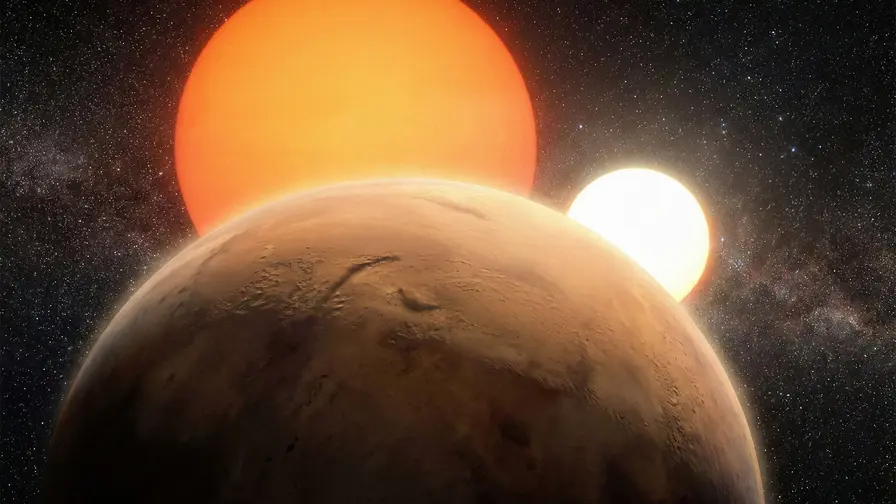
Read More Scince News Space 2 months ago Three Earth-size Worlds Orbiting Dual Suns: TOI-2267 TESS and ground observatories uncovered three Earth-size planets orbiting both stars of the compact binary TOI-2267. This rare configuration challenges models of planet formation and opens new paths for atmospheric and dynamical studies.
Read More Scince News Space 2 months ago Photonic Lantern Sharpens Telescope Views of Stars Now A UCLA-led team used a photonic lantern on the Subaru Telescope to capture unprecedented high-resolution images of a star's disk, revealing a surprising asymmetry and opening new avenues for high-resolution ground-based astronomy.
Read More Scince News Space 2 months ago Cosmic Bat Nebula: Newborn Stars Light Up a Haunted Cloud A wide-field VST image reveals a red, bat-shaped nebula (RCW 94/95) 10,000 light-years away. Optical Hα and infrared VISTA data expose active star formation, dusty filaments and stellar feedback.
Read More Scince News Space 2 months ago Webb Unveils the Red Spider Nebula's Hidden Heart James Webb Telescope images of NGC 6537, the Red Spider Nebula, reveal a dust-enshrouded core, massive molecular-hydrogen lobes and jets that suggest a hidden companion shaping the dying star.
Read More Scince News Space 2 months ago New Radio Mosaic Reveals the Milky Way in Vivid Color A new GLEAM/GLEAM-X radio mosaic from the Murchison Widefield Array maps the Milky Way at 72–231 MHz, revealing magnetic fields, supernova remnants and star-forming regions in vivid radio colour.
Read More Scince News Space 2 months ago How AI Saved and Sharpened the $10B Webb Telescope Australian researchers used AI to remove detector-caused blurring in the James Webb Space Telescope's AMI instrument, restoring sharp imaging of exoplanets, Io and distant stars without any hardware repairs.
Read More Scince News Space 2 months ago Jupiter’s Early Growth and the Meteorite Delay Revealed New Rice University simulations show Jupiter's early growth created rings and pressure traps that gave rise to a second generation of planetesimals, explaining why many chondritic meteorites formed millions of years after the first solids.
Read More Scince News Space 2 months ago Neutrino Clues: How Matter Survived the Big Bang Era NOvA and T2K scientists combined data to probe neutrino oscillations and CP violation, offering stronger hints why matter, not antimatter, survived the Big Bang. IU researchers played key roles.
Read More Scince News Space 2 months ago First Glimpse of a Young Sun’s Super-Eruption Captured Astronomers observed a two-temperature coronal mass ejection from EK Draconis, a young Sun-like star. Hot plasma at ~100,000 K and cool gas at ~10,000 K reveal how stellar eruptions could shape planetary atmospheres and habitability.
Read More Scince News Space 2 months ago Did Cold War Nuclear Tests Trigger Mysterious Sky Lights? A reanalysis of the 1949–1958 Palomar sky survey shows transient lights cluster around above-ground nuclear tests and UAP reports, suggesting some mid-20th-century anomalies were real atmospheric or anthropogenic events.
Read More Scince News Space 2 months ago Dry Ice Sandworms: How CO2 Carves Sinuous Martian Gullies Laboratory simulations show dry ice (CO2) can burrow through Martian dune sand as it sublimates, reproducing sinuous gullies with levees and terminal pockets — a water-free explanation for seasonal features.
Read More Scince News Space 2 months ago Why It Rains on the Sun: New Clues from Solar Plasma New simulations from the University of Hawai‘i reveal that time-variable concentrations of heavy elements in the solar corona can trigger rapid coronal rain, reshaping our view of coronal heating and plasma dynamics.
Read More Scince News Space 2 months ago Frozen Building Blocks of Life Found in Another Galaxy Astronomers using JWST detected complex organic molecules frozen in ice around a protostar in the Large Magellanic Cloud, including acetic acid — the first such icy detection beyond the Milky Way.
Read More Scince News Space 2 months ago Nearby Super-Earth GJ 251c: A Close Habitable Candidate Astronomers have identified GJ 251c, a nearby super-Earth candidate about 18 light-years away in its star's habitable zone. The discovery, made via radial velocity, makes this world a prime target for future direct imaging and atmospheric study.
Read More Scince News Space 2 months ago Hubble Reveals NGC 6951's Radiant Ring of Starbirth Hubble’s image of NGC 6951 reveals a glowing circumnuclear starburst ring fueled by a central bar. Learn how gas inflow creates intense star formation and why astronomers repeatedly study this galaxy.
Read More Scince News Space 2 months ago Bizarre Titan Crystals That Defy a Chemistry Rule — New Study Laboratory experiments and computer models suggest hydrogen cyanide on Titan can form stable co-crystals with methane and ethane at -180 °C, challenging the 'like dissolves like' rule and altering interpretations of Titan's surface and prebiotic chemistry.
Read More Scince News Space 2 months ago Hearing Black Holes Ring: Hawking’s Area Theorem Verified GW250114, a clarifying black hole merger detected by upgraded LIGO detectors, provided the strongest observational test yet of Hawking's black hole area theorem and revealed distinct ringdown modes.
Read More Scince News Space 2 months ago Could Dark Matter Be Behind the Milky Way's Gamma Glow? New Milky Way simulations show the galactic-center gamma-ray excess could come from flattened dark matter annihilation as easily as millisecond pulsars. Upcoming telescopes may settle the debate.
Read More Scince News Space 2 months ago Scientists Spot Proto-Earth Traces Hidden in Ancient Rocks MIT-led researchers detected a subtle potassium-40 deficit in ancient rocks that may preserve fragments of the proto-Earth predating the Moon-forming giant impact, challenging assumptions about early planetary mixing.
Read More Scince News Space 2 months ago Hidden Sun-Grazing Asteroid 2025 SC79 Discovered Near Earth Astronomers discovered 2025 SC79, a 700‑m Atira asteroid hidden near the Sun. With a 128‑day orbit inside Earth's path, it highlights detection limits, impact risks, and the need for improved twilight and space‑based surveys.