Read More Scince News Space a month ago AI Maps 100 Billion Stars: Faster, Sharper Milky Way Sim Japanese researchers used AI to build a Milky Way simulation that tracks over 100 billion stars at single-star resolution, cutting run times from decades to months and opening new avenues for galaxy science.
Read More Scince News Space a month ago Hidden Deep: How Core Leaks Shaped Earth's Habitability New geodynamic research links deep mantle anomalies—LLSVPs and ULVZs—to core–mantle mixing in a basal magma ocean. This core leakage may have shaped Earth's cooling, volcanism, and habitability.
Read More Scince News Space a month ago How Mantle Waves Peel Continents and Feed Volcanoes Researchers propose slow 'mantle waves' peel deep continental roots and transport continental material into the oceanic mantle, explaining distant volcanic enrichment, diamond-bearing magmas, and long-term uplift.
Read More Scince News Space a month ago Our Solar System May Be Moving Far Faster Than Expected Analysis of deep radio surveys suggests the Solar System may be moving more than three times faster through space than standard cosmology predicts. The surprising cosmic radio dipole challenges assumptions about large-scale uniformity.
Read More Scince News Space a month ago Could a 'Metal-Free' Galaxy Truly Hide the First Stars? A distant galaxy, CR3, shows almost no heavy elements and a very young stellar population. If confirmed, it may host Population III stars — the Universe’s first generation — found much later than expected.
Read More Scince News Space a month ago Moss Survives Nine Months in Space — A Boost for Mars Plans Moss spore capsules exposed on the ISS survived nine months in space, with over 80% remaining viable. The experiment suggests spores' resilience could inform astrobiology and future ecosystem plans for the Moon and Mars.
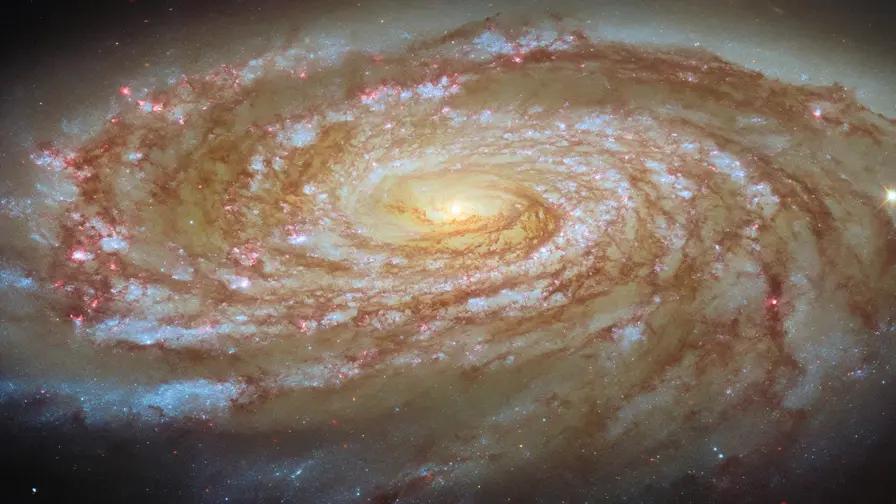
Read More Scince News Space a month ago How Frozen Clouds in NGC 4571 Spark New Stars Today Hubble's new image of NGC 4571 highlights how frozen molecular clouds collapse into newborn stars. Multi-observatory data from HST, JWST, ALMA and PHANGS-HST reveal dusty, ionized nebulae and the stages of star formation.
Read More Scince News Space a month ago Listening to Cosmic Dawn: 13-Billion-Year Radio Clues Astronomers propose that the ancient 21-centimeter radio signal can reveal masses and behavior of the universe’s first stars. New models tie REACH and SKA capabilities to Population III signatures.
Read More Scince News Space a month ago Plasmasphere Under Siege: Inside the May 2024 Superstorm Detailed observations from JAXA’s Arase satellite reveal how the May 2024 geomagnetic superstorm crushed Earth’s plasmasphere, slowed recovery for days, and disrupted satellites, GPS and communications.
Read More Scince News Space a month ago Why NASA Is Watching the Growing South Atlantic Anomaly NASA and international missions are tracking the South Atlantic Anomaly, a growing region of weakened magnetic field that affects satellites and offers insights into Earth's deep-core dynamics and space weather.
Read More Scince News Space a month ago Did Water Persist Beneath Mars' Dunes? New Findings NYU Abu Dhabi researchers found evidence that shallow groundwater once cemented sand dunes in Gale Crater, depositing gypsum that could preserve organics and extend the window for habitability on Mars.
Read More Scince News Space a month ago Skydiver Silhouetted Against the Sun: The Preposterous Photo Astrophotographer Andrew McCarthy and skydiver Gabriel C. Brown pulled off a carefully timed shot: a human silhouetted against the Sun. The image required precise timing, pilot coordination and advanced astro gear.
Read More Scince News Space a month ago Cosmic Cooling: Why the Universe Is Running Out of Stars New analysis of 2.6 million galaxies using Euclid and Herschel data shows the universe is cooling and star formation is declining, suggesting a long-term shift toward a darker, colder cosmic future.
Read More Scince News Space a month ago Volcanic Sulfur May Have Made Early Mars Habitable New University of Texas research suggests reduced sulfur gases from ancient Martian volcanoes could have created a warming greenhouse effect, shaping potentially habitable environments and offering insights relevant to EV infrastructure and materials science.
Read More Scince News Space a month ago Chaotic Spiral Galaxy NGC 1511: Collision Aftermath Revealed Hubble's image of NGC 1511 shows a spiral galaxy still reshaping after collisions with smaller companions. Warped arms, a hydrogen bridge and fresh starbursts reveal how galactic crashes drive evolution.
Read More Scince News Space a month ago Cloud Clues: New Color Key to Find Alien Life, Telescopes Cornell researchers mapped reflectance spectra of colorful cloud microbes, creating a new toolkit to spot biosignatures on cloudy exoplanets. The discovery affects telescope design, sensor tech and parallels automotive sensor development.
Read More Scince News Space a month ago Continents Peeling From Below: Hidden Mantle Highways Researchers find that deep “mantle waves” can peel off fragments of continental roots and sweep them into the oceanic mantle, explaining continental-like geochemistry in remote volcanic islands and reshaping views of mantle transport.
Read More Scince News Space a month ago GJ 251 c: A Nearby Super-Earth 18 Light-Years Away Astronomers have identified GJ 251 c, a nearby super-Earth about 18 light-years away in its star's habitable zone. Observations with HPF and NEID suggest a rocky planet that could host liquid water; future direct imaging with TMT could confirm its nature.
Read More Scince News Space a month ago Hidden Giant: NGC 4102's Quiet Supermassive Black Hole Hubble and Chandra unveil a quietly active supermassive black hole at the center of NGC 4102. This nearby, Compton-thick LINER offers insight into low-luminosity AGN and galaxy evolution.
Read More Scince News Space a month ago Inside SN 2024ggi: First View of a Supernova Tearing Open Astronomers used VLT spectropolarimetry to capture the shock-breakout of supernova SN 2024ggi, revealing an elongated, olive-shaped explosion and clues to the star's final geometry and possible binary history.